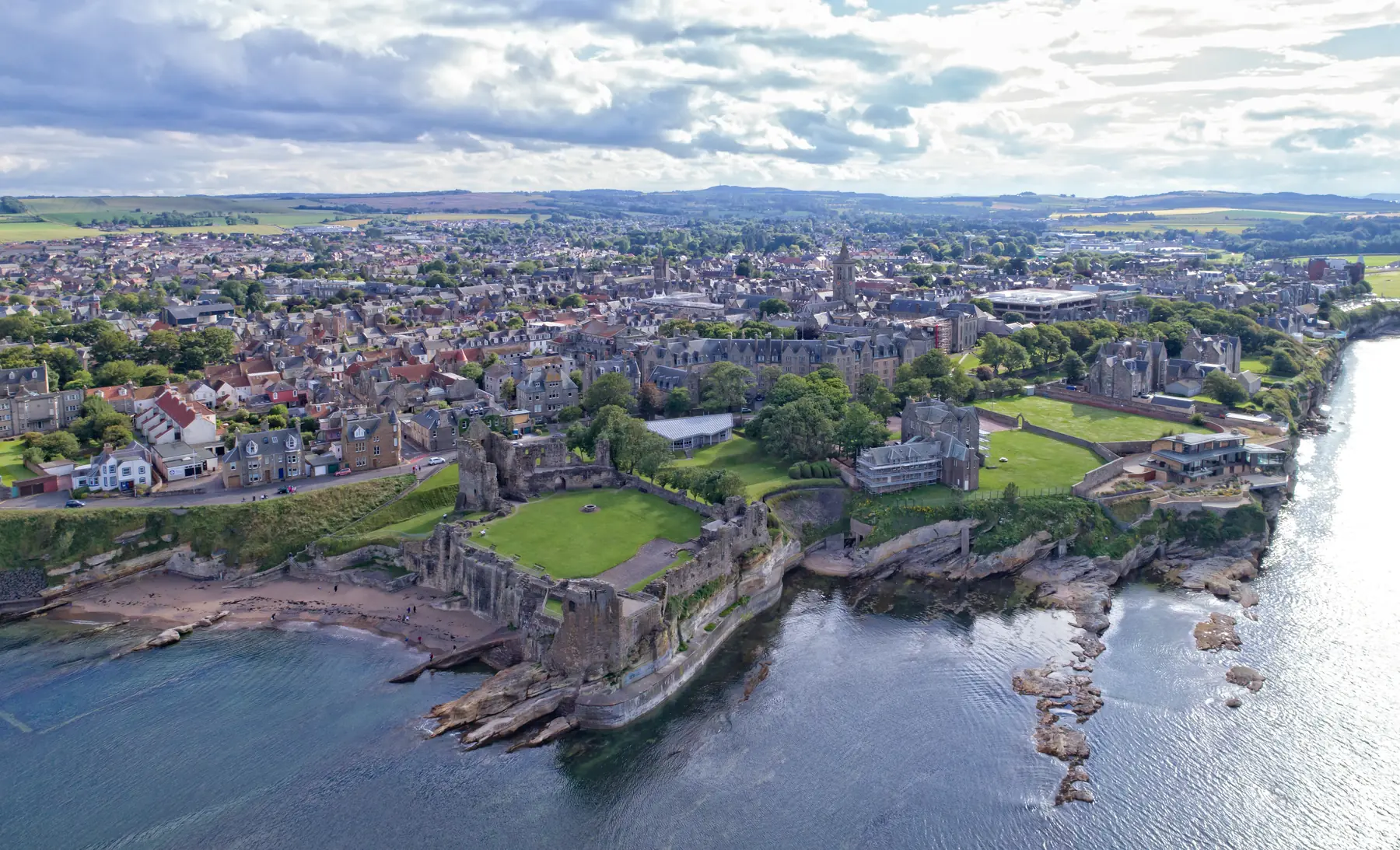
St Andrews calls itself the home of golf. The claim needs a small qualification and then it stands up: the game was not invented here — it came from the Low Countries and was adopted in Scotland in the Middle Ages, played over natural ground of no fixed length, with the first rulebook written in Edinburgh in the eighteenth century.
What St Andrews did was decide what golf is. The Royal and Ancient Golf Club, founded here in 1754, established the eighteen-hole round as standard and codified the rules that the rest of the world adopted. The R&A now co-governs the game worldwide from a clubhouse at the end of a public street, looking out over a course anyone can walk on.
There are seven public links courses at St Andrews, run by the St Andrews Links Trust on land owned by the town. They are, in descending order of fame:
The Old Course — the oldest golf course in the world, and the one. Double greens, blind shots, the Swilcan Bridge, the Road Hole and the Hell Bunker.
The New Course — opened in 1895, which tells you something about the timescales here. Many golfers consider it the better test.
The Jubilee — the toughest of the three big links, opened in 1897.
The Castle Course — the newest, on the cliffs south of the town, with a completely different character and enormous views.
The Eden, Strathtyrum and Balgove — the shorter courses, the last of these a nine-hole beginners’ course.
The essential facts.
It is a public course. Anyone can play it. There is no membership requirement and no need for an introduction.
Tee times are hard to get. Some are released in an advance ballot, some are allocated by a daily ballot — you enter by two o’clock two days before, and find out that evening whether you have a time. A proportion of times go to visitors booked through the advance system, and a queue for single golfers operates at the first tee.
You need a handicap certificate — the Links Trust sets a limit, and you should check the current requirement when booking.
It is closed on Sundays. The course is common land, and on Sundays it reverts to being a park that the town walks across. This is not a quirk to be worked around; it is the arrangement that makes the whole thing possible.
Caddies are available and are, on the Old Course more than most, genuinely worth the money — the blind shots and the double greens are close to unreadable without local knowledge.
Green fees are high and seasonal, and the shoulder-season and winter rates are considerably lower than the summer ones.
Several things, all of them good.
Play one of the others. The New and the Jubilee are proper links on the same ground, far easier to book, and considerably cheaper. Many golfers who have played all three rate the New highest.
Play the Castle Course for the setting — clifftop, modern, and the best views of any course here.
Play the Himalayas. The St Andrews Ladies’ Putting Club’s eighteen-hole putting green sits beside the Old Course, is open to the public, costs very little and is played on a surface of wild undulations. It is enormous fun, it takes an hour, and a great many people enjoy it more than a round.
Walk it instead. On Sunday the Old Course is open to walkers. Standing on the Swilcan Bridge and walking up the eighteenth fairway to the R&A clubhouse costs nothing.
The first tee is a public spectacle. It sits at the end of a town street with the R&A clubhouse beside it, there is usually a small crowd, and watching people hit the opening shot of their lives is free entertainment.
The eighteenth green is equally open, with the Rusacks and the town behind it.
The Open Championship returns to the Old Course roughly every five years and is the largest event the town holds. The Alfred Dunhill Links Championship comes every October and plays the Old Course, Carnoustie and Kingsbarns. In both weeks the town is completely full and accommodation goes months ahead.
Opposite the clubhouse, and the national museum of the game — clubs, balls, the evolution of the rules, the Open trophies and a great deal of social history. It is well done, and it is interesting even to people who do not play, because in St Andrews the history of golf and the history of the town are the same thing.
Booking. The Links Trust handles all seven courses. Advance times for the Old Course are released well ahead and go quickly; the daily ballot is the other route.
Weather. Links courses drain almost instantly and rain rarely stops play. Wind is what closes them, and an east-coast gale here is a serious proposition.
Kit. Waterproofs, a hat that stays on, and more layers than the temperature suggests.
Etiquette. Pace of play is taken seriously, caddies will tell you what to do, and nobody minds a bad round — they mind a slow one.
Getting there. The courses are at the western edge of the town, five minutes’ walk from the centre. There is a Links clubhouse with changing facilities and a shop.
Worth knowing, because it explains why a public course in a small Scottish town is the most famous in the world.
Golf was being played on this ground by the fifteenth century — well enough established that James II banned it in 1457 on the grounds that it was distracting his subjects from archery practice. The links, the strip of sandy ground between the town and the sea, was common land used for grazing, drying nets, rabbit warrening and games, and golf was one of the things people did on it.
The Society of St Andrews Golfers was founded in 1754 and became the Royal and Ancient Golf Club in 1834. In 1764 the Society reduced the course from twenty-two holes to eighteen — and because the R&A’s rules were the ones the rest of the world adopted, eighteen became the number everywhere.
The double greens, the vast bunkers with names, the blind shots over gorse: none of it was designed. The Old Course was shaped by sheep, rabbits, the wind and four hundred years of people walking over it, and it is the reason golf architecture looks the way it does.
Green fees on the Old Course are high, seasonal and considerably higher in summer than in winter — and the winter rate on a links course that drains in minutes is one of the better value propositions in golf, if you can stand the wind.
The other six courses are all substantially cheaper, and the Links Trust sells multi-course tickets that work out better again for anyone playing several rounds. Caddies, buggies and club hire are extra.
If the budget will not stretch, the Himalayas putting green costs a few pounds and the Sunday walk across the Old Course costs nothing at all.
Yes. It is a public course, with tee times allocated by advance booking and a daily ballot, subject to a handicap limit.
Through the advance booking system, released well ahead, or by entering the daily ballot two days before play. Single golfers can also queue at the first tee.
It is common land belonging to the town, and Sunday is the day it reverts to public use. Walking across it is a local tradition.
Play the New, the Jubilee or the Castle Course, all excellent and far easier to book — or the Himalayas putting green, which costs very little.
For the Old Course, yes — the Links Trust sets a limit. Check the current requirement when booking.