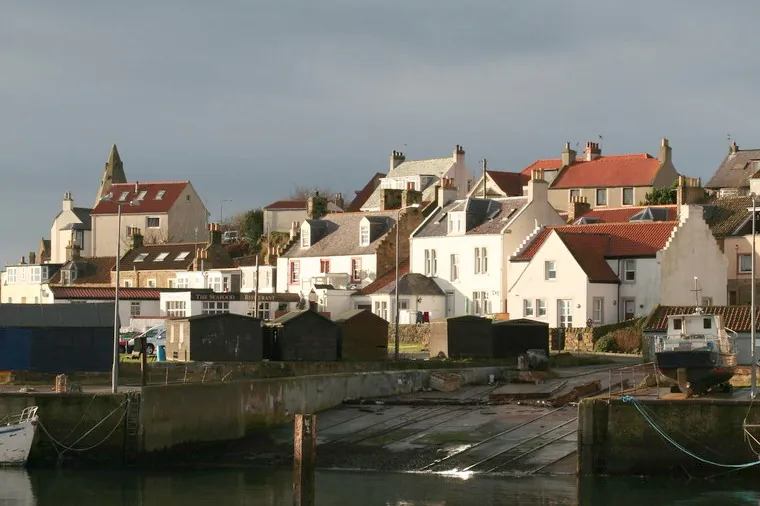
St Monans, sometimes spelt St Monance, is a village and parish in the East Neuk of Fife, named after the legendary Saint Monan, who was killed by invading Danes in about 875. It is small and getting smaller: the civil parish held 1,357 people in 2011 and 1,120 at the 2021 census. The former burgh sits on a hill above the Firth of Forth, its people once living mainly by fishing, and looks out to North Berwick, the Bass Rock and the Isle of May.
The reason to come from St Andrews is that almost everything here is on the shoreline rather than in the streets: a 14th-century church on the rocks west of the houses, a ruined castle half a mile beyond it, and the other way along the coast a tidal swimming pool, the remains of a salt-panning industry and the windmill that powered it. Between them the village is a run of vernacular fisher and merchant houses of the 17th to early 19th centuries, with forestairs, crow-stepped gables, datestones and pantiled roofs.
The straight-line distance from St Andrews is 14.9 km. It stands on the Fife Coastal Path, which is how many people arrive.
St Monans Church, dating from 1369, sits west of the village on a low rock above a small valley with a burn, the sea behind it from most directions. It is often said to be the church nearest the sea in the whole of Scotland, at around 20 m from the edge. King David II Bruce built it, initially for a small house of Dominican friars, and it later became the Church of Scotland parish church. It may never have been finished — there is a choir, transepts and a short spire over the crossing, but no nave.
The original graveyard surrounds it; from the west end of the later cemetery on the slope above, which holds the war memorial, the ruin of an earlier church can be seen across fields, also on the sea edge.
Access is the uncertain part. The church has been open to visitors daily from April to October; a service of closure as a formal place of worship was held on 19 October 2025.
About half a mile (800 metres) west are the remains of Newark Castle, a 16th-century manor fallen to ruin through cliff erosion and disrepair; an attempt to restore it in 2002, with the permission of Historic Scotland, was unsuccessful. It carries 4.2 from 130 Google reviews, the lowest score of anything listed in the village.
Salt production by evaporation was a traditional East Neuk industry, and St Monans keeps the now defunct windmill that once powered its salt panning. The East Neuk Salt Company has revived the trade in the village.
On the same stretch of shore is St Monans Tidal Pool, 4.7 from 161 Google reviews, and it is the main draw now. It is a short walk out of the village along the coast, and it is bare: a visitor in July 2026 wrote, “Is a little barren but we liked that. No life guard or facilities.” The same review carries the practical warning — “Take some kind of swimming shoes or trainers as jaggy stones and rough around the sides” — and adds that the pool “Is not too deep but maybe keep an eye if you have kids”. A visitor in June 2026 called it “very well looked after”, with “a few benches around to get changed at”.
It is warmer than the open sea, which is not the same as warm. A visitor in May 2026 swam for half an hour in “skins and neoprene socks, gloves and cap” and reported, “End of May; the temp of the pool was much warmer than the sea.” That reviewer walked on to Pittenweem and swam on the way back, which is the shape most visits take: a stop on a coast walk rather than a destination by itself.
Like the other East Neuk harbours this one began as a natural inlet sheltered by rock outcrops. The first mention of a built harbour is from 1649. The east pier dates from 1865, designed by David and Thomas Stevenson; their nephew Charles Alexander Stevenson added the west pier in 1902 and deepened the harbour for larger vessels. In 1883 the Fishery Board reported that the fishermen had put up a good harbour at a cost to themselves of about £15,000. St Monans Harbour carries 4.7 from 29 Google reviews, too few to weigh heavily.
The trade left more than piers. There is a fish merchant and a fish smokehouse in the village, along with several restaurants and cafés, holiday homes and a caravan park. For over 200 years J W Miller & Sons Ltd built fifie fishing boats, yachts and motor launches here; no boats are built in the village now.
Two places carry most of the reviews. Giddy Gannet, a café, holds 4.9 from 353 Google reviews — a visitor in July 2026 wrote, “I really enjoyed the salmon bagel - the fish was so fresh.” East Pier is listed at 4.6 from 586 Google reviews, mostly for food and the view. Scores that high say the people who bothered to review liked it, not that nobody was disappointed.
Two Stagecoach South Scotland services run through St Monans. The 95 runs between Leven and St Andrews by way of Anstruther and Crail; the X61 runs from Edinburgh to St Andrews via Kirkcaldy and Leven. Both link the village directly with St Andrews.
There is no train. St Monance station, spelt St Monans between 1875 and 1936, stood at the entrance to the village on the East Neuk Rail Line, part of the Fife Coast Railway, closed in the 1960s under the Beeching cuts. An industrial estate occupies the site; the overgrown south platform and the station master’s house, now a private home, survive.
The last option is to walk in: the village is on the Fife Coastal Path, and the St Monans to Pittenweem section is listed separately at 4.9 from 13 Google reviews, a sample too small to mean anything.
The village and what is around it, at walking scale.
Open any of them in Google Maps for directions and current opening.
Attractions, prices and availability in St Andrews
These come from GetYourGuide's booking widget, which sets their cookies in your browser. Consent to load it and see the attractions and prices.
Background on St Monans draws on its Wikipedia article, text there being available under CC BY-SA 4.0.