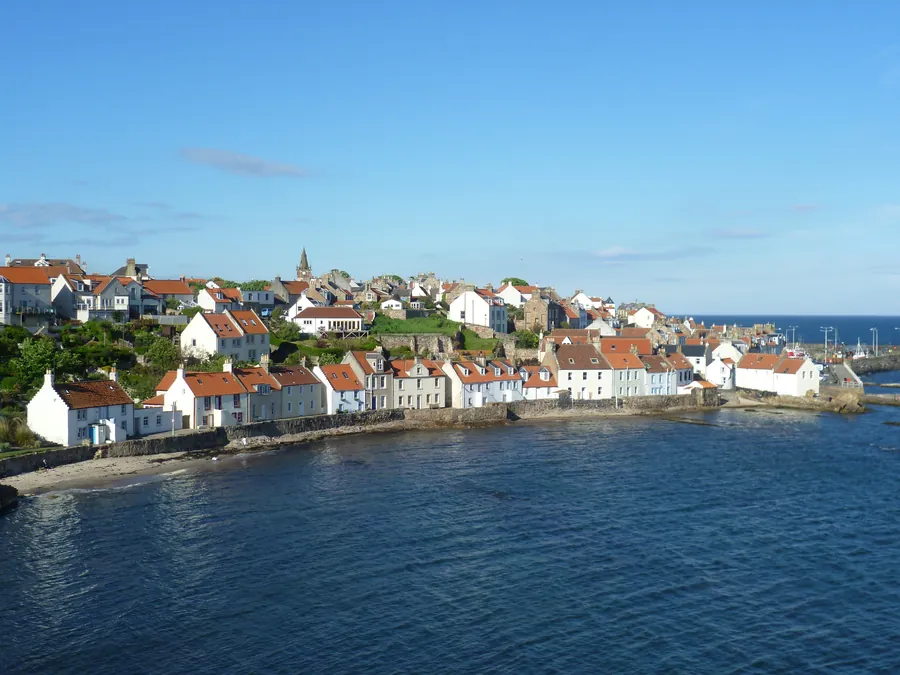
Pittenweem is a fishing village and civil parish on the east coast of Fife, with a population of 1,747 at the 2001 census. It is the one village along this coast where the harbour still does the job it was built for: it the most active of the fishing ports on the East Neuk coast of Fife. That is the reason to come out from St Andrews — a used harbour rather than a preserved one, in a village reshaped by the shrinking of its own fleet.
The straight-line distance from St Andrews is 14.5 km.
The name covers the other half of the visit. “Pit-” is the Pictish pett, a portion of land, and “-enweem” the Gaelic na h-Uaimh, “of the Caves” — the Place of the Caves, after St Fillan’s Cave, which is still open, on the condition that you go and fetch the key.
The village grew along the shoreline from the west, where sheltered beaches let fishermen draw their boats up out of the water. A breakwater was later built out from one of the rocky skerries that jut south-west into the Firth of Forth, letting boats lie at anchor instead of being beached, and a second breakwater to the east grew into a deep, safe harbour. Unlike ports further up the Forth such as Buckhaven and Largo, fishing here went on prospering up to the First World War.
Pittenweem Harbour carries 4.6 from 426 Google reviews, and they are about watching rather than doing. A visitor in July 2026 wrote, “lovely harbour, seals and herons can be seen”. A visitor in June 2026 preferred it late: “Lovely to see a working harbour and walk round later in the evening when its quite”. A warning from May 2026, if you eat outside: “Watch out for passing gulls.”
The cave is the oldest structure in the village, dating from the 7th century. An Augustinian priory linked to the monastery on the Isle of May moved here in the 13th century and was built over it, though a church already stood here; Pittenweem Parish Church, attached to the tolbooth, has a Norman doorway from before 1200. The cave is fitted out as a chapel, rededicated for worship by the Bishop of St Andrews in 1935.
At 4.3 from 198 Google reviews it is the lowest-rated of the village’s listed attractions, partly because it is exactly what the name says. A visitor in July 2026 wanted more from it: “Needed more information about the importance of the cave in earlier times.” Another that month noted that “Donations welcomed for the upkeep of the caves.”
Access is the thing to know before walking down. A visitor in July 2026 was emphatic: “The key to enter the cave MUST be obtained from the cocoa tree café”. The same review places it in Cove Wynd, a lane running down towards the water.
The tolbooth holds the darker history. In the late 17th and early 18th centuries the local minister ran a series of witch-hunts, and it served as the jail for the Pittenweem witches: five women were severely beaten and one was murdered by a lynch mob. Pittenweem was a royal burgh from 1541, granted by James V, until 1975.
In the late 1960s the fishermen marked the reopening of the redesigned harbour with a Gala Day: boats dressed overall, short trips run on them for the public. By the early 1980s regulation, fuel costs and a shrinking fleet had brought it to its knees, and in 1982 an Arts Festival took its place, keeping the Gala Day at first as its finale. It has since become one of the best-loved art festivals in Scotland, with an estimated 25,000 visitors in 2013, and artists drawn by the light of this coast have settled here.
The festival holds 4.5 from 145 Google reviews. A visitor in July 2026 caught the village while it runs: “There is nothing like walking along the sea with a good buzz of people popping in and out to look at art and have a friendly chat”. A visitor in August 2025 was measured about the strain on a place this size: “Pittenweem could do with maybe one more coffee shop to support the quantity of visitors”.
The timing matters: the festival runs once a year. The rest of the year this is a small working village with a harbour, a cave, a few streets and a coast path.
The village sits astride a raised beach, which is why the old part climbs from the water in steps and wynds. Pittenweem Tidal Pool is listed at 4.9 from 121 Google reviews, one of the highest ratings here, though no reviews come with that rating, so nothing can be said about the water or the sides.
Neighbouring St Monans has a tidal pool too, 4.7 from 161 reviews, reached from Pittenweem on foot. A visitor in May 2026 walked it in that direction: “we walked from there to Pittenweem and stopped for a swim in the pool on the way back”, finding at the end of May that “the temp of the pool was much warmer than the sea”. The Fife Coastal Path section between the two villages is listed separately at 4.9 from 13 reviews, too few to weigh. That same stretch of coast carried a series of coal mines in the 18th century.
The transport notes in this pack record no St Andrews to Pittenweem service, so there are no journey times or frequencies to give. Stagecoach East Scotland buses serve the village; check the current timetable for route numbers and whether they run through to St Andrews.
There is no train. The Fife Coast Railway served the village at one time; that line closed in 1965, having run on around the coast to St Andrews, and the remaining line into St Andrews from Leuchars closed in 1969. Passenger services from Edinburgh to Leven were restored in 2024, the new station sitting next to the bus station there. The other way in is on foot, along the Fife Coastal Path from the neighbouring East Neuk villages, which is how several reviewers arrived.
The village and what is around it, at walking scale.
Open any of them in Google Maps for directions and current opening.
Attractions, prices and availability in St Andrews
These come from GetYourGuide's booking widget, which sets their cookies in your browser. Consent to load it and see the attractions and prices.
Background on Pittenweem draws on its Wikipedia article, text there being available under CC BY-SA 4.0.