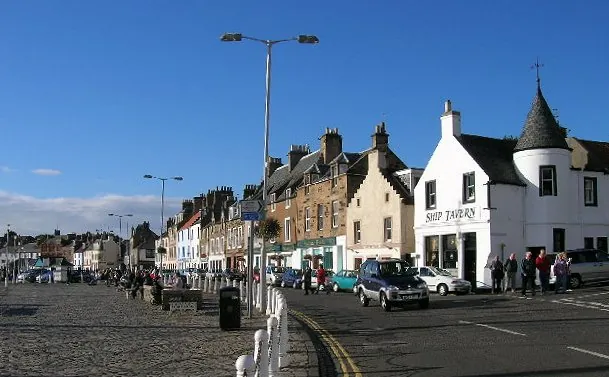
Anstruther is a coastal town of 3,500 people on the north shore of the Firth of Forth, and the largest community in the part of Fife known as the East Neuk. It was founded as a fishing village, and the fishing is over. What is left is the harbour the industry built, a museum of that industry standing on it, and a boat that runs out of it to an island of puffins.
The straight-line distance is 14.1 km. Locally it is called Ainster or Enster, and it is not one settlement but two — Anstruther Easter and Anstruther Wester, divided by a stream called the Dreel Burn. To the east it merges with the village of Cellardyke.
You go for the harbour front and the boat — and the boat is a weather decision rather than a plan, so the town has to carry the day on its own.
The harbour you walk around is Victorian infrastructure. The Board of Fisheries built a new one here in the 1870s, completed by 1877, when herring still justified that kind of work. Recreational vessels are moored in it now. It carries 4.6 from 747 Google reviews, and a visitor in July 2026 wrote, “Beautiful harbour area, tidy, nice views and shops on the street.” Anstruther Beach is listed separately at 4.8 from 29 Google reviews, too few to lean on.
Not everyone leaves warm. A visitor in May 2026 left one star and wrote, “Visiting from Canada, I found the atmosphere in Anstruther unwelcoming.” The complaint was about being told off for sheltering from rain near a residential doorway on Shore Street, where houses and shopfronts share the same terrace.
Inland, the two Anstruthers keep their own furniture. The parish church stands at the centre on a small hill, with a tower and spire form rare in Britain but common in this corner of Fife. In Anstruther Wester, the 17th-century Dreel Tavern takes its name from the burn beside it. Nearby is Buckie House, late 17th century, its east gable decorated in the mid 19th century with scallop shells and whelks — buckies — by the slater Andrew Batchelor. The war memorial, further inland in the cemetery, is unusual in being entirely flat to the ground, a Celtic cross laid out in a landscaped roundel.
The town has several fish and chip shops, one of them a destination in its own right: the Anstruther Fish Bar won Fish and Chip Shop of the Year in 2001–2002 and took the Sea Fish Organisation’s award again in 2009.
Anstruther Pleasure Cruises run sightseeing and wildlife trips from the harbour to the Isle of May aboard the May Princess, from April to October. The island is the UK’s primary puffin location, with seal colonies as well. The trips carry 4.8 from 382 Google reviews.
The sailing is at the mercy of the sea: a visitor in July 2026 wrote, “A trip that depends a lot on weather,” and added, “prepare for sea sickness as this could change the mood of the boat ride very quickly.” The island itself is bare. The same visitor noted, “Apart from restroom facilities nothing else on the Isle as such but birds,” and that the boat allows two hours ashore, which is short if you have come to watch them properly. Take a windproof layer.
The reviews are not unanimous: a visitor in July 2026 gave two stars over remarks they overheard the skipper making on the radio about the passengers, while saying “the trip itself was great.” East Neuk Outdoors, an activity operator in the town, carries 4.8 from 131 Google reviews.
Fishing here is old enough to have been worth a papal ruling. In 1225 it took the intervention of Pope Honorius III to settle a teinds dispute between the monks of Dryburgh Abbey and the fishermen of Anstruther — evidence that the fishing was good enough to be worth arguing over. In December 1583 James VI granted the town royal burgh status and trading rights, recognising the importance of the port, then called the draucht of Anstruther. James Melville’s diary records the arrival of a ship of the Spanish Armada, and local tradition holds that some survivors stayed and married into the town.
By the 19th century Anstruther-Easter had tanning, shipbuilding and fish-curing works alongside a coasting trade. The end came quickly. A drop in the catch in 1909 was a shock but not fatal; herring fishing carried on into the mid-20th century, and after a record catch in 1936 the shoals mysteriously declined until the industry had effectively disappeared by 1947.
The Scottish Fisheries Museum tells that story, on ground in Anstruther Easter gifted to Balmerino Abbey in the 1280s, where a chapel once stood. It holds 4.6 from 345 Google reviews, and reviewers say it outruns expectations: a visitor in May 2026 wrote, “The museum is much bigger and comprehensive than you might think.”
Two oddities sit outside the fishing story. Anstruther has Scotland’s only true-scale model solar system: the Sun, the planets and the distances between them all at one scale of 1 to ten thousand million, set out mostly in the town centre and stretching almost 600 m from the Sun to Pluto. And on the B940 near the town there is a secret nuclear bunker, built in 1951 and operational until 1993, disguised through its working life as an ordinary house. It was a subsidiary regional seat of government for a nuclear emergency, and is now open as a museum.
Walkers can leave town eastward along the coastal path towards Crail, which passes the Caves of Caiplie.
The bus is the connection. Stagecoach East Scotland runs two services through Anstruther: the 95 from Leven to St Andrews via Pittenweem and Crail, and the X60 from Edinburgh to St Andrews via Kirkcaldy, Leven and Pittenweem. St Andrews services leave from the bus station off South Street, a couple of hundred metres from the centre.
There is no train. Anstruther was connected to St Andrews by the North British Railway by the First World War and well served by trains on the Fife Coast Railway, but that line closed to passengers in 1965; St Andrews has no station of its own either.
The village and what is around it, at walking scale.
Open any of them in Google Maps for directions and current opening.
Attractions, prices and availability in St Andrews
These come from GetYourGuide's booking widget, which sets their cookies in your browser. Consent to load it and see the attractions and prices.
Background on Anstruther draws on its Wikipedia article, text there being available under CC BY-SA 4.0.