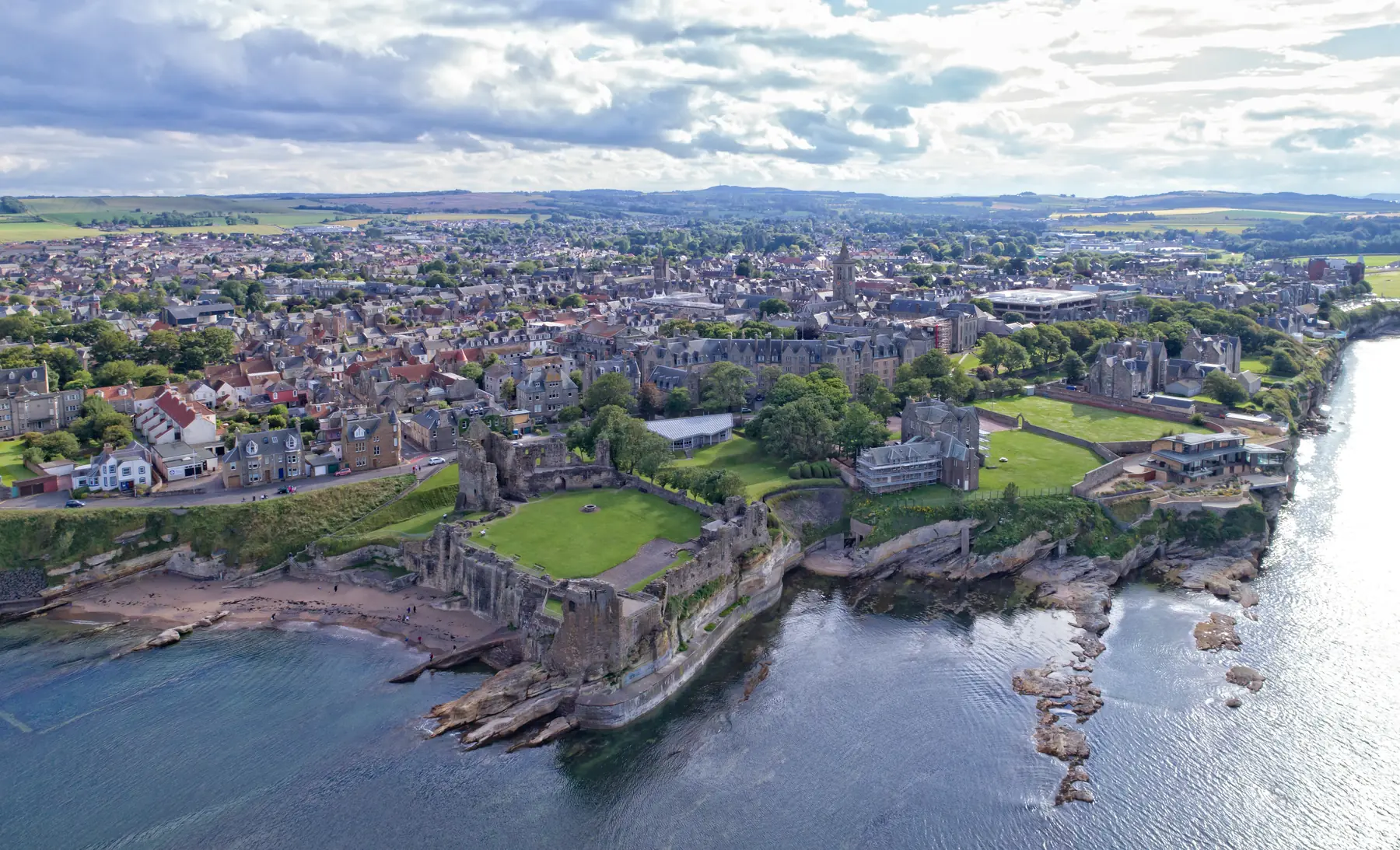
Two ruins stand at the eastern end of St Andrews, four hundred metres apart on the cliff, and between them they tell the story of how a Fife fishing settlement became the most important town in Scotland and then stopped being it inside a generation.
They are the reason to come here after the golf, and for a good many visitors they are the better half of the trip.
Building began in 1158, and when it was finished it was the largest church ever built in Scotland — around 120 metres long. It was the seat of the Archdiocese of St Andrews and the centre of the medieval Catholic Church in the country, and it drew pilgrims from across Europe to the relics of the apostle Andrew.
What survives is fragmentary and enormous: the east gable standing to its full height at the end of South Street, the west front, sections of the nave walls, and the outline of the whole building marked in the turf. The scale is the thing — you walk into it expecting a ruin and find yourself in a footprint bigger than most cathedrals still standing.
Around it lies one of the largest and most atmospheric graveyards in Scotland, running to the cliff edge.
The square tower beside the cathedral is older than the cathedral — early twelfth century, built as part of an earlier church. It stands thirty-three metres and you can climb it: a tight spiral staircase to a viewing platform with the whole town, both beaches, the golf links and the coast laid out below.
It is the best view in St Andrews and the climb is a genuine effort.
A collection of carved stones in the precinct includes the St Andrews Sarcophagus, an eighth-century Pictish carved shrine and one of the finest pieces of early medieval sculpture in Britain.
Four hundred metres along the cliff, on a rocky promontory above Castle Sands, stands what is left of the bishops’ castle — a fortified residence rather than a military fortress, built and rebuilt from the late twelfth century.
Two things make it exceptional.
A pit cut down into the solid rock beneath the Sea Tower, shaped like a bottle with a narrow neck and a wide base, seven metres deep. Prisoners were lowered into it through the neck. Nobody escaped. You look down into it through a grille, and it is one of the more sobering things in Scottish heritage.
In 1546 the castle was under siege. The attackers began tunnelling towards the walls to bring them down; the defenders, hearing them, dug a counter-tunnel to intercept — and, after two failed attempts, broke through into the attackers’ mine.
Both tunnels survive, and you can go down and along them. They are cut through solid rock, they are low and narrow in places, and they are the best-preserved example of siege mining anywhere in Britain. Going into them is the single most memorable thing at either site.
The history is worth knowing because it explains why both buildings are ruins.
St Andrews was the ecclesiastical capital of Scotland, and in the sixteenth century it became the centre of the Scottish Reformation’s most violent phase.
Patrick Hamilton was burned outside St Salvator’s Chapel in 1528, aged twenty-four — his initials are set into the cobbles on North Street, and student superstition holds that treading on them will cost you your degree.
George Wishart was burned in front of the castle in 1546, watched, according to tradition, by Cardinal David Beaton from the castle window.
Three months later a group of Protestant lairds murdered Beaton in the castle and hung his body from the same window. They held the castle for a year — during which the siege mine was dug — until a French fleet bombarded it into surrender. John Knox, who had joined the garrison as a preacher, was taken and spent nineteen months as a galley slave.
Knox returned in 1559 and preached in the town church. Within days the cathedral was stripped, and it was never repaired; the town’s people carried away its stone for houses over the following centuries.
The Martyrs’ Monument on The Scores commemorates the Protestants; the cathedral commemorates itself.
Both sites are run by Historic Environment Scotland, with a joint ticket covering the two, which is the sensible option since they are four hundred metres apart.
Allow two to three hours for both, more if you climb St Rule’s Tower and take your time in the graveyard.
Accessibility. The cathedral precinct is largely level; St Rule’s Tower is a tight spiral staircase; the castle mine is low, uneven and unsuitable for anyone with mobility difficulties or claustrophobia.
Opening is seasonal, with shorter winter hours, and the tower closes in high wind.
Free from outside. The precinct and the graveyard are open, and a good deal of both ruins is visible from the surrounding streets and the cliff path.
St Andrews Pier, below the cathedral, is where the students walk in their red gowns on Sunday mornings in term — a tradition of long standing and free to watch.
Castle Sands, below the castle, has a natural rock pool and is where the May Dip happens at dawn on the first of May.
The Scores, the clifftop road linking the two sites to the golf links, is the best short walk in the town.
Early morning for the cathedral precinct, when the light comes off the sea into the east gable and the graveyard is empty.
Late afternoon for the castle, when the sun comes round onto the cliff.
A rough day for both. These are ruins on a cliff above the North Sea, and a big grey sea running below the castle walls does more for the atmosphere than sunshine ever will.
Sunday morning in term for the Pier Walk, when students in red gowns process out along the harbour pier and back after chapel — a tradition that has been going for well over a century and costs nothing to watch from the cathedral precinct above.
Tickets. Historic Environment Scotland runs both and sells a joint ticket. Members go free, and the joint ticket is worth it if you are doing both, which you should.
Time. An hour to an hour and a half at the cathedral including St Rule’s Tower; forty-five minutes to an hour at the castle including the mine. Longer if you walk the graveyard properly, which is worth doing.
Winter. Both have shorter opening hours from October to March, and the tower closes in high wind. Check before travelling.
Building began in 1158. It was the largest church ever built in Scotland and was abandoned after the Reformation in 1559.
Yes — a spiral staircase of thirty-three metres to a viewing platform with the best view in St Andrews. It closes in high wind.
A bottle-shaped pit cut seven metres into the rock beneath the castle’s Sea Tower, entered only through a narrow neck at the top.
Yes. The 1546 mine and countermine are open and you can walk and crawl through them. They are low and narrow in places.
Yes, Historic Environment Scotland sells one covering both the cathedral and the castle, which are four hundred metres apart.