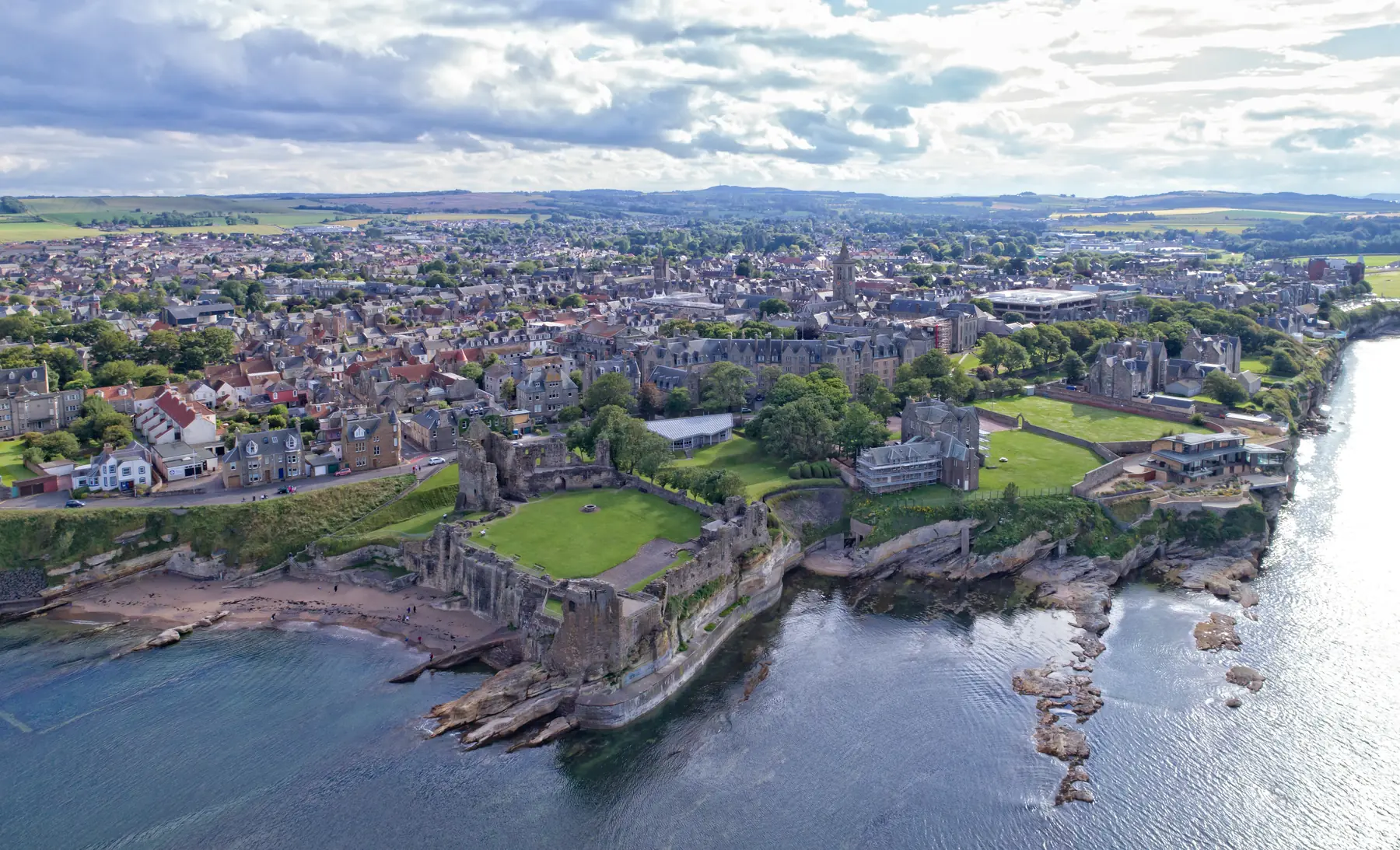
St Andrews faces the North Sea on the east coast of Scotland, which means wind more than rain — the town is drier than the Scottish average, sitting in the rain shadow of the country’s high ground, but what it gets it gets horizontally.
For a town of sixteen thousand people it has an unusual concentration of indoor things to do, because it has a six-hundred-year-old university with museums attached, a golf industry with its own national museum, and a nuclear bunker down the road.
Opposite the Royal and Ancient clubhouse at the end of the links, and the national museum of the game — clubs, balls, trophies, the history of the rules, and a good deal on the Open Championship. It is well done and it does not require you to care much about golf to be interesting, because the history of the game and the history of the town are the same story.
An hour and a half. See our Golf Museum page.
Several venues in and around the town run indoor simulators and practice facilities, which is how a considerable number of visiting golfers spend a day when the links are unplayable. The links themselves rarely close for rain — they are sand-based and drain almost instantly — but they do close for wind.
On The Scores, and the university’s own museum: the collections of an institution founded in 1413, including scientific instruments, the university’s medieval maces, art and a good deal of curious material. There is a rooftop terrace with a view over the bay. Free.
A Victorian natural history museum in the Bute Building, largely unchanged since it was arranged — glass cases, taxidermy, skeletons and specimens. Its opening hours are limited, so check, but it is a small time capsule and worth catching.
The town museum in Kinburn Park covers local history; the St Andrews Heritage Museum and Garden on North Street is a small volunteer-run museum in a historic house with a garden behind.
Scotland’s Secret Bunker, ten kilometres south, is a Cold War command centre buried thirty metres under a Fife farmhouse — blast doors, operations rooms, dormitories, a broadcasting studio and a chapel, kept secret until 1993. It is the single most weatherproof attraction in the area and one of the strangest.
St Andrews Castle’s mine and countermine, in the town, is a genuine 1546 siege tunnel you can walk down. It is underground, though the rest of the castle is not.
Kingsbarns Distillery, ten kilometres south-east, is a Lowland malt distillery in a converted farm steading with tours, a tasting bar and a café. It also makes gin. A good ninety minutes indoors.
The town’s restaurants, cafés and pubs are numerous for its size — a student population does that — and the streets between North Street and South Street are short enough to move between them without getting properly wet.
St Andrews Cathedral is roofless and enormous, and it is arguably more impressive in bad weather than in sun — the scale of what was destroyed reads better under a grey sky. St Rule’s Tower beside it can be climbed for the view, though not in high wind.
The castle on its promontory with a big sea running is a considerable sight.
Both are Historic Environment Scotland sites with visitor centres for shelter.
Dundee, twenty kilometres north across the Tay, has the V&A Dundee on the waterfront, Discovery Point with Scott’s Antarctic ship, the McManus Galleries and the Verdant Works jute museum. It is the best full wet-day escape and it is half an hour away.
Edinburgh is an hour and a half by road or by train from Leuchars.
The East Neuk villages — Anstruther, Pittenweem, Crail — have the Scottish Fisheries Museum at Anstruther, which is substantial and indoors, and a great many small galleries and cafés.
Falkland, half an hour west, has a Renaissance palace with an indoor real tennis court, the oldest in Britain.
Craigtoun Country Park and the Botanic Garden both have tree cover and glasshouses.
West Sands is exposed but the walk is short and a big sea on it is worth seeing.
The town’s three streets and the cathedral precinct are a decent hour in a shower.
Wind, not rain, is what stops things here. Golf is cancelled for wind; boat trips likewise.
Leuchars station, ten kilometres west, has two trains an hour to Edinburgh and Dundee, which makes the escape easy.
Opening hours for the smaller museums, particularly the Bell Pettigrew, are limited. Check before setting out.
Term time matters for the university museums, some of which have restricted vacation hours.
The shape that works: the castle first, going straight down into the siege mine, which is underground and unaffected; then the cathedral and St Rule’s Tower if the wind allows, both a few minutes away. Lunch on Market Street. Then the R&A World Golf Museum or the free Wardlaw Museum for the afternoon, and a pub.
If it has set in for the day, drive or take the bus south to Scotland’s Secret Bunker, which is thirty metres underground and takes a comfortable two hours, or north to Dundee for the V&A and Discovery Point.
Worth understanding. Fife sits on the east coast in the rain shadow of Scotland’s high ground, and St Andrews is significantly drier than the west — annual rainfall here is closer to the English midlands than to the Highlands.
What it gets instead is wind and, in late spring and early summer, haar: a cold sea fog that rolls in off the North Sea, sits on the coast and can drop the temperature by ten degrees while the countryside a few miles inland is in sunshine. The response to haar is to go inland — Craigtoun, Falkland, Cupar — rather than to go indoors.
St Andrews is three parallel streets, which makes moving between doorways easy. Market Street and South Street carry most of the cafés, bookshops and small independents, and the wynds between them are short.
The university adds a layer most towns this size do not have: bookshops, a serious café culture, and public lectures and exhibitions through term. The Byre Theatre on Abbey Street runs performances, film and a café and is a good place to be in bad weather.
And the town’s pubs are numerous, old and entirely comfortable with people dripping in the door — a student town takes a relaxed view of appearances.
The R&A World Golf Museum, the free Wardlaw Museum, Scotland’s Secret Bunker ten kilometres south, and the castle’s underground siege mine.
Yes, the university’s museum on The Scores is free to enter.
Rarely — the links are sand-based and drain fast. Wind is what closes them.
A Cold War nuclear command centre thirty metres underground, kept secret until 1993 and now a museum. Entirely weatherproof.
Dundee, half an hour north, for the V&A, Discovery Point and the museums.