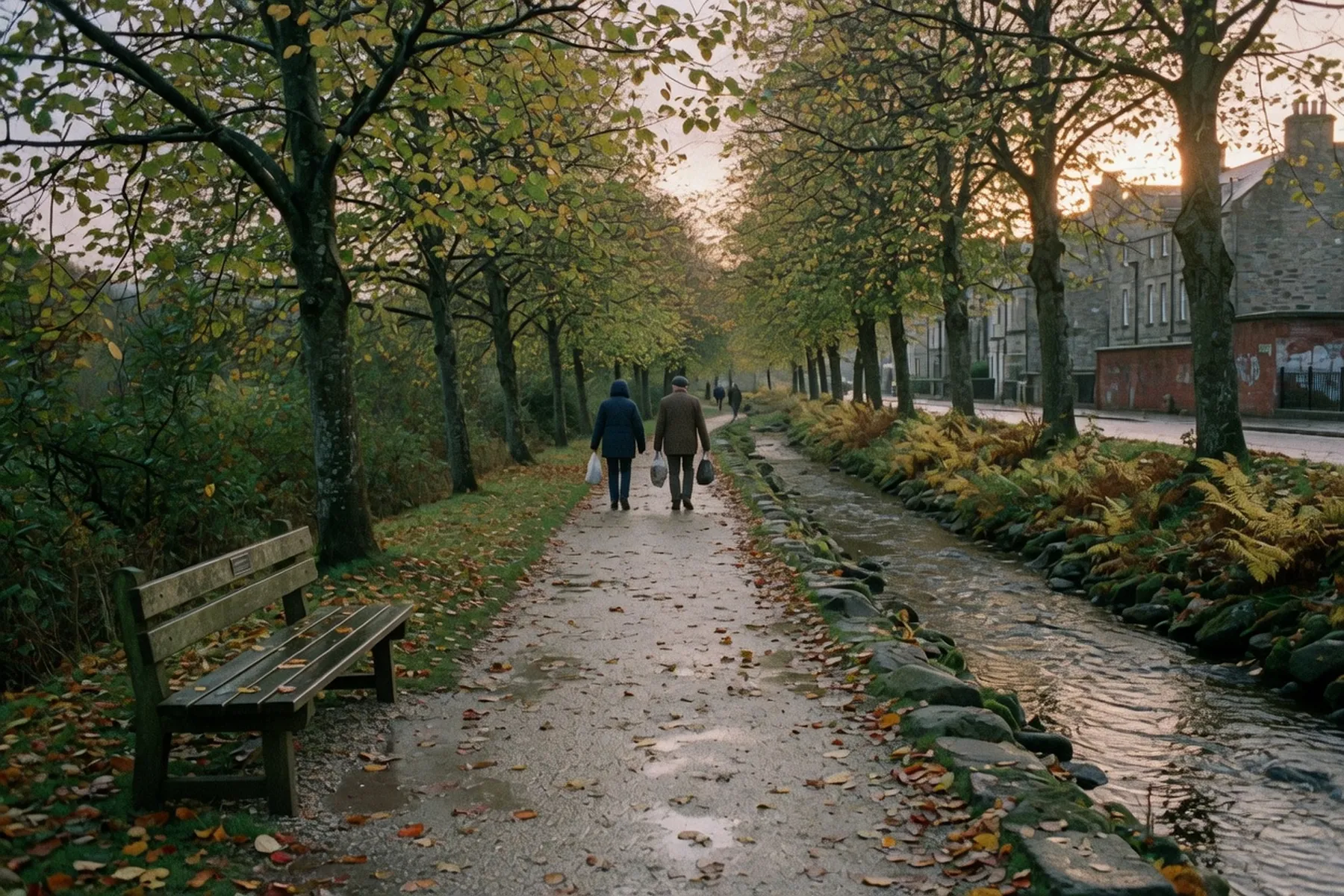
The Lade Braes is the walk St Andrews keeps for itself: a burn-side path that runs out of the town beside the Kinness Burn and ends, two kilometres on, at the gates of St Andrews Botanic Garden. It is not a climb and not a coast walk but a long, mostly level green thread through the south of the town, past two parks and a line of small memorials, and it carries more of the town’s working history than most visitors expect. The name is the first clue: a lade is an artificial watercourse, and the braes are the slopes above it. The path follows the very watercourse that once drove the Priory’s mills, and at its far end the mill pond still holds the water.
The path runs 2 km from the town centre to Law Mill, and the whole line is walkable without a car and without a timetable. It starts at South Street, beside the former Madras College building at Lade Braes Lane, and is a shared-use route that stays largely level the whole way. It leaves the town through Queens Terrace and Louden’s Close, crosses Melbourne Place at a light-controlled crossing, and runs green through the parks before reaching Law Mill, where seats sit by the mill pond and the remains of the lade weir mark the end. The length is the figure to plan around; your own pace sets the time. The route is also a stretch of the Fife Pilgrim Way, so on a busy day you will share it with long-distance walkers heading out of town.
Most write-ups of the Lade Braes still describe the pre-2021 path, which is one reason this page exists. Fife Council led a rebuild that began in October 2021 and, after snagging delays, was completed in October 2023. It was funded by £345,000 from Sustrans’ Places for Everyone programme — money that comes from Transport Scotland and is managed in Scotland by the Walk Wheel Cycle Trust — plus a £100,000 contribution from the council itself. The works widened the path to roughly 2.25–3 metres, laid an all-weather bound-gravel surface, and added ground-level solar studs, “Share With Care” signage, seating, bins and removable bollards. Recorded use rose by about a third, from roughly 83,000 trips in 2019 to roughly 110,000 in 2024, and the share of a survey calling the route well lit climbed from 20% to 33% once the studs went in.
The town end of the walk is the busy bit. Queens Terrace and Louden’s Close take you out to Melbourne Place, where a light-controlled crossing carries the path over the one real road it meets. After that the character changes: Cockshaugh Park and Woodburn Park open green on either side of the burn, good places to slow down or sit, and the Kinness Burn Viaduct carries the path over the burn itself. Past the viaduct the route settles into the tree-lined upper braes, and the traffic of the town drops away behind you.
Two families left their names along the upper braes. The John McIntosh memorial fountain and the John Milne memorials belong to the people who landscaped this stretch in the late 1800s, and they are worth the pause they ask for. Hallow Hill, an ancient burial site, sits beside the route further on. Treat it with the care any burial ground asks for; we have not verified who manages it or what surface runs across it, so do not assume a surfaced path onto the hill itself.
The lade may predate the Priory of St Andrews, founded in 1140, and its first written reference is 1479. It was cut to carry water to the Priory’s mills — the Abbey Mill and the Shore Mill — fed by a weir below Law Mill, and the water served for washing, cleaning and drinking until it was polluted by 1697. Between 1845 and 1890 the burn was progressively covered in pipes, the section by Madras College going under around 1845–54. Higher up, a skating pond at Balnacarron, whose sluice is still visible, had gone by about the 1950s, and a curling pond and clubhouse near Little Carron, built around 1906, was later replaced by a play area in the 1980s. The mill pond at Law Mill is what remains of all that water.
Autumn is the path’s best hour. Low sun through wet leaves, the burn high after rain, the gravel pale under the trees — it is a short, bright season and it ends quickly. Spring brings fresh green and blossom, summer shade under the canopy, and winter a colder, wetter walk where the all-weather surface earns its name. The garden’s clock moves with the same calendar: from April to September it opens 10:00–17:00, and from October to March 10:00–16:00.
St Andrews Botanic Garden sits on Canongate, KY16 8RT, a registered charity (SC036705), and it is the natural end to the walk. It opens daily year-round except from Christmas Eve to New Year, and last entry is 30 minutes before closing. Hours are 10:00–17:00 from April to September and 10:00–16:00 from October to March. Entry costs £7.50 for an adult (Gift Aid inclusive) and £6.20 for over-60s, while children up to 16 go free, St Andrews University students go free with ID, and Friends of the garden and carers go free. Parking on site is free, there is a visitor centre with a gift shop, and pets are not permitted except assistance dogs. The garden may close in extreme weather, and its own page has the details: our Botanic Garden page covers the visit in fuller form.
The walk works best as a line from South Street, and the return is the same path in reverse, which reads differently in the other direction. Buses serve the town end, but the timetable belongs to the operator and changes, so check at the bus station rather than trusting a number remembered here. If you are driving only for the garden, it has its own free parking on Canongate, which is the honest answer to the parking question the walk itself does not settle. Our walks around St Andrews page sets the Lade Braes beside the town’s other routes.
The rebuild is what matters here. The all-weather surface now runs the rebuilt length, and a motorised-wheelchair user has published a video riding the roughly one-mile completed section end to end — that is what the source shows, so say it plainly and no more. Pushchairs manage the surfaced path in ordinary weather. We have not verified every metre, or the ground up at Hallow Hill, so treat this as the completed section being rideable rather than a promise about the whole hillside.
From Law Mill a longer day can push on to Craigtoun Country Park, which is a fuller outing than the braes alone. Or keep the braes as the quiet half of a day that also takes in the town. The path’s place on the Fife Pilgrim Way means it can also be the first, unhurried leg of a much longer journey, but most people come for the burn, the trees and the garden at the end.
The garden’s own Eventbrite page is the place to check, because listings change. As of early October it lists the Little Oaks Early Years Group on Tuesday 6 October 2026 at 10:30; garden maintenance volunteering on Wednesday 7 October and nursery volunteering on Thursday 8 October, both recurring; a talk by Kate Danesh on restoring an 18th-century walled garden on Thursday 22 October 2026 at 17:30; and a Burton Hall Garden Design talk on planting for wild landscapes on Thursday 19 November 2026 at 17:30. Check the garden’s Eventbrite page before travelling for any of them, and read the board by the gate for the rest.