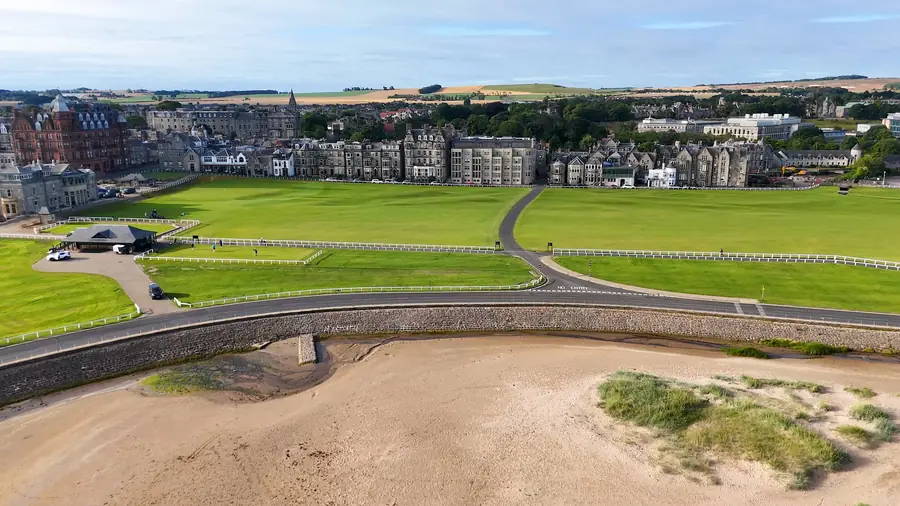
The Old Course at St Andrews — the Old Lady, the Grand Old Lady — is generally reckoned the oldest golf course in the world, and golf has been played on this ground since at least the early fifteenth century.
The crucial and often-missed fact about it is that it is a public course on common land, held in trust by the St Andrews Links Trust under an Act of Parliament. It is not a private club’s property.
The Royal and Ancient Golf Club clubhouse sits beside the first tee, and the R&A is the game’s rule-making body — but it is one of several clubs with playing privileges, alongside the St Andrews Golf Club, the New Golf Club, the St Regulus Ladies Golf Club and the St Rule Club, together with the general public.
The Old Course was not designed. It evolved, on links land shaped by wind and rabbits, and its peculiarities are historical accidents that became sacred.
Seven enormous double greens, shared between two holes each, with two flags. This happened because the course was originally played out and back over the same ground.
Bunkers — 112 of them, small, deep, revetted and often invisible from the tee. Several have names and reputations: Hell Bunker on the 14th, the Road Hole Bunker on the 17th, Strath on the 11th.
The Road Hole, the 17th, is widely called the hardest hole in championship golf: a blind drive over a reconstruction of the old railway sheds, to a green with a bunker in front and a road and stone wall immediately behind it, both of which are in play.
The Swilcan Bridge, a small stone bridge on the 18th fairway, perhaps 700 years old and originally for shepherds crossing the burn. Every departing champion is photographed on it.
The Valley of Sin, the dip in front of the 18th green.
The Open Championship has been played here 30 times, more than anywhere else.
Walk it — on a Sunday. The Old Course is closed to golf on Sundays and is open to the public as a park. You can walk the fairways, stand on the Swilcan Bridge and look into Hell Bunker, for nothing. This is the single best piece of advice about St Andrews and a surprising number of visitors do not know it.
Walk the perimeter any day — public paths run along the course and across the 18th, and the West Sands beach runs alongside.
Guided walking tours run in the evenings in season.
The ballot. Most public tee times are allocated by a daily ballot: you enter two days ahead, in person, online or by phone, and the draw is published that afternoon. Entrants must have a handicap certificate — 24 for men, 36 for women.
Advance reservations open roughly a year ahead and are heavily oversubscribed.
Singles can join the queue on the day at the starter’s box, sometimes successfully, often not.
Caddies are available and, on a course with blind shots and invisible bunkers, are close to essential for a first round.
The other courses — the New, the Jubilee, the Eden, the Strathtyrum, the Balgove and the Castle Course — are all part of the same Links Trust, are far easier to get onto, and are excellent. The New Course in particular is rated by many as the better test.
Free to walk on Sundays and around the perimeter any day.
Location: the first tee is at the end of Golf Place, five minutes from the town centre.
The R&A World Golf Museum is opposite the clubhouse.
West Sands — the two-mile beach used for the opening scene of Chariots of Fire — runs alongside.
No — it is a public course on common land held in trust under an Act of Parliament. The R&A clubhouse is beside it but does not own it.
Yes — the course is closed to golf on Sundays and open to the public to walk, for free.
Mostly by daily ballot entered two days ahead, with a handicap certificate required. Advance reservations open about a year ahead.
The 17th, the Road Hole — a blind drive, a deep bunker and a road and stone wall behind the green.
Yes — the New, Jubilee, Eden, Castle and others are all Links Trust courses, much easier to book, and very good.