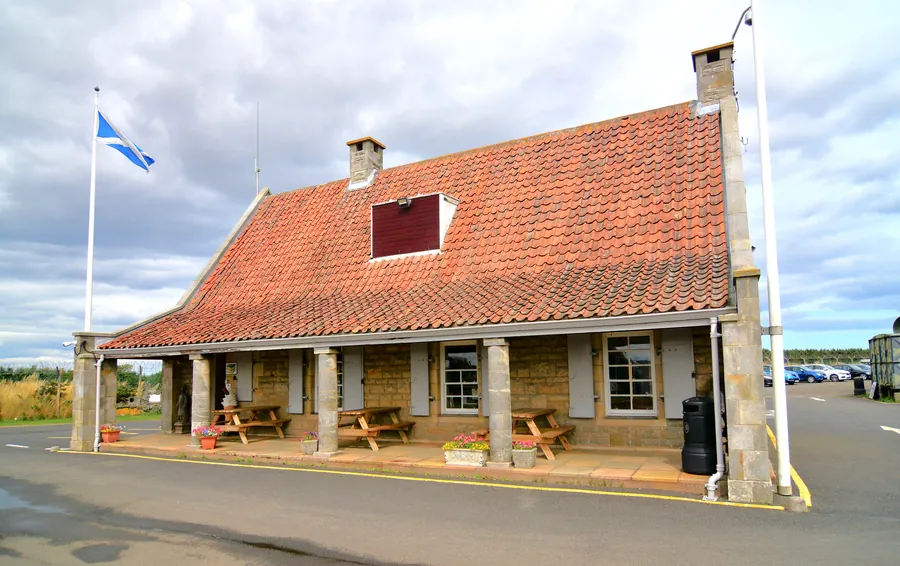
Ten kilometres south-east of St Andrews, a road sign points to Scotland’s Secret Bunker, which is a contradiction that has drawn a great many visitors off the A917.
Behind an ordinary-looking farmhouse is a ramp leading down a 150-metre tunnel to 24,000 square feet of reinforced concrete, buried 30 metres underground behind three-metre-thick walls and blast doors.
It was built in 1951 as an RAF radar station, converted into a Regional Government Headquarters, and remained operational and officially secret until 1993.
In the event of nuclear war, this is where the government of Scotland would have gone.
The bunker housed a Regional Seat of Government: civil servants, military officers and a designated Regional Commissioner who would have exercised effectively unlimited authority over Scotland after a strike, with the rest of the country’s administration destroyed or unreachable.
It had capacity for around 300 people, with its own power, water, air filtration and food for months, and communications to the rest of the national network.
The people in the villages above did not know it was there.
Almost everything, still in place. This is the bunker’s great quality: it was not stripped and it is not a reconstruction.
The command centre and operations rooms, with the plotting boards and consoles.
The BBC studio from which emergency broadcasts would have been made, with the scripts.
The dormitories, canteen, sick bay and decontamination area.
The switchboard and communications rooms, with the original equipment.
The chapel.
Two cinemas showing period public information films — including Protect and Survive, the government’s advice to the population, which is worth watching and is genuinely chilling.
Displays on civil defence, nuclear weapons and the Cold War, plus vehicles and hardware.
Visitors repeatedly make the same point: this is not a museum of objects gathered from elsewhere. It is the place it happened, with its own things still in it, which is a different proposition entirely.
This is the one piece of advice everybody who has been gives.
You need three hours, minimum. There is far more down there than the entrance suggests, and visitors who arrive ninety minutes before closing consistently report having to rush and regretting it — the site is large, the displays are dense, and the films take time.
Arrive by early afternoon at the latest. Check the closing time before you set off.
Admission charged.
Time: three hours minimum.
Facilities: café, shop, toilets.
Parking: free on site.
Access: the bunker is reached down a long ramped tunnel and has stairs between levels; check accessibility in advance.
Underground: it is cool, artificially lit and windowless. Some visitors find it oppressive; most find that part of the point.
Children: it works from about eight upwards, and older children and teenagers do very well with it.
Season: open through the main season with reduced winter operation. Check before travelling.
Signposted off the B940 near Troywood, about fifteen minutes from St Andrews by road.
A Regional Government Headquarters — the underground command centre from which Scotland would have been governed after a nuclear attack. Operational and secret from 1951 until 1993.
About 30 metres underground, behind three-metre-thick concrete walls, reached by a 150-metre tunnel.
Three hours minimum. Visitors who allow less consistently say they had to rush.
Yes — the equipment, rooms and fittings are largely as they were, not reconstructed.
From about eight upwards, and it works particularly well with older children and teenagers.