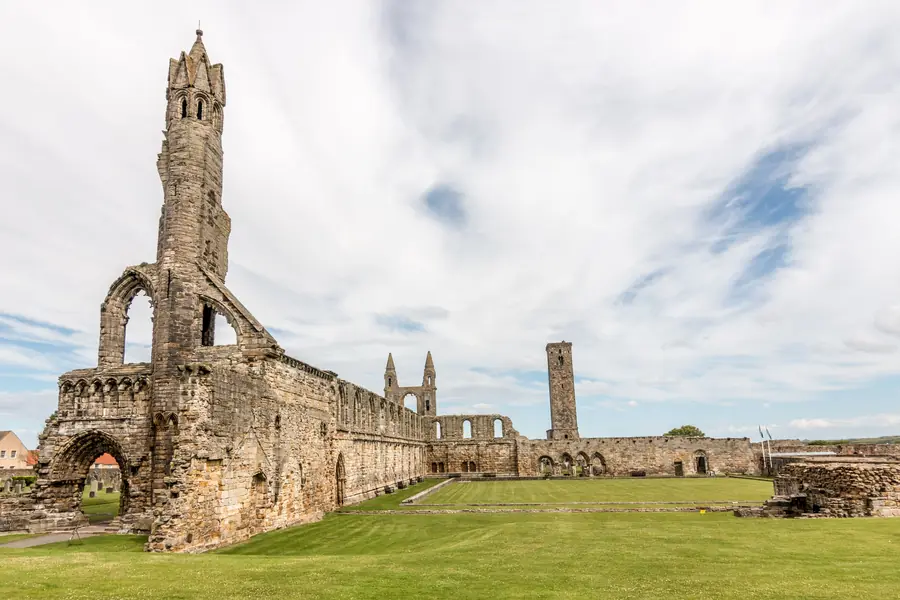
St Andrews Cathedral was begun in 1158 and was, at 119 metres long, the largest church ever built in Scotland.
It was the seat of the Bishops and Archbishops of St Andrews and the centre of the medieval Church in Scotland, and it stood for four hundred years before the Reformation stripped it and the roof came off.
What is left is a ruin of enormous scale: the east gable standing to full height, the west front, long stretches of the nave walls, and the whole footprint laid out on the grass with the sea beyond.
St Andrews was the religious capital of Scotland, and the reason was relics.
The tradition holds that in the fourth or eighth century a monk brought bones of the Apostle Andrew to this coast, and the settlement that grew around the shrine became Scotland’s principal pilgrimage destination. Andrew became the country’s patron saint, and his diagonal cross became the flag.
The cathedral was built to house the shrine, and pilgrims came from across Europe.
11 June 1559. John Knox preached in the parish church of St Andrews, and the congregation went to the cathedral and stripped it — altars, images, furnishings.
The building was not destroyed; it was abandoned. Catholic mass was outlawed, the cathedral had no function, and over the following century the roof fell in and the stone was carried away for buildings in the town. That, rather than any deliberate demolition, is why it looks as it does.
St Rule’s Tower — a square tower of about 1130, part of the earlier church on the site and older than the cathedral itself. It is 33 metres high, you can climb it by a narrow spiral stair of 156 steps, and the view over the town, the cathedral, the Old Course and the coast is the best in St Andrews. It is the single thing most worth doing here.
The museum in the undercroft, which holds one of the finest collections of early medieval carved stones in Scotland — including the St Andrews Sarcophagus, an eighth-century Pictish shrine chest carved with a hunting scene of astonishing quality. It is one of the great pieces of European early medieval sculpture and it is not well enough known.
The precinct wall, largely complete, with its towers.
The graveyard, which contains Young Tom Morris’s memorial — the four-times Open champion who died at 24.
The cathedral grounds are free to walk in. The museum and St Rule’s Tower are ticketed by Historic Environment Scotland, free to members and to English Heritage members after a qualifying period.
Time: an hour, more with the tower and museum.
Access: the grounds are grass, largely level. The tower is 156 narrow spiral steps and is not accessible.
Season: the tower and museum have seasonal hours; the grounds are open more widely.
St Andrews Castle is five minutes along The Scores.
The Pends, the vaulted gateway into the precinct, leads down to the harbour and East Sands.
St Andrews Pier — the walk out along it after Sunday chapel is a university tradition.
About 119 metres long — the largest church ever built in Scotland.
It was stripped during the Reformation in 1559, abandoned, and then lost its roof and its stone over the following century. It was not deliberately demolished.
Yes — St Rule’s Tower, 156 narrow spiral steps, with the best view in St Andrews. It is ticketed.
The grounds are free. The museum and tower are ticketed by Historic Environment Scotland.
The St Andrews Sarcophagus, an eighth-century Pictish carved shrine chest in the site museum — one of the finest pieces of early medieval sculpture in Europe.