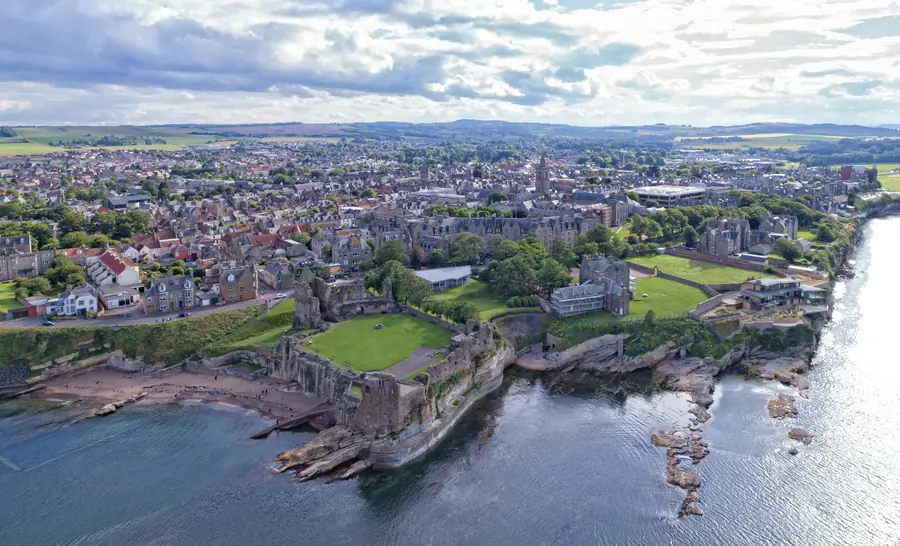
St Andrews Castle stands on a rocky promontory on The Scores, overlooking Castle Sands and the North Sea, and it was never primarily a military fortress. It was the palace of the bishops and archbishops of St Andrews — the most powerful churchmen in Scotland.
There has been a castle here since the time of Bishop Roger (1189–1202), son of the Earl of Leicester. What stands is largely later, repeatedly destroyed and rebuilt.
Cut into the solid rock beneath the Sea Tower is a bottle-shaped pit: narrow at the neck, widening below, about seven metres deep, with no door and no window.
Prisoners were lowered in through the hole in the floor. There was no way out and no way to climb the walls, which curve inward. Waste was not removed. Bodies were sometimes not removed either.
It is the most notorious prison in Scotland, and you can look down into it through a grille. It is the thing every visitor remembers.
The castle’s other extraordinary feature is a piece of sixteenth-century siege engineering that survives complete.
In 1546, Cardinal David Beaton — Archbishop, Chancellor of Scotland, and the man who had the Protestant preacher George Wishart burned at the stake in front of the castle — was murdered in his own bedchamber by Protestant lairds, who hung his body from the walls.
They held the castle. The siege that followed lasted more than a year, and John Knox joined the garrison inside.
The besiegers, working for the Governor, began a mine — a tunnel driven through solid rock to undermine the walls. The defenders heard them and dug a counter-mine to intercept it. They got it wrong twice and had to start again; the third attempt broke into the attackers’ tunnel and the mine was abandoned.
Both tunnels survive, and you can go down into them. They are lit, low and narrow, and crawling through a sixteenth-century siege mine is not an experience available anywhere else in Britain.
Note: the mine is occasionally closed for safety or conservation, and visitors who came specifically for it and found it shut have said so. Check before travelling if it is your main reason for coming.
The siege ended in 1547 when a French fleet arrived and bombarded the castle. The survivors, Knox among them, were sent to the French galleys.
The Sea Tower, the Fore Tower, the kitchen tower and ranges around a courtyard, mostly ruined but legible.
The position — a cliff above a small beach, with the sea on two sides and the cathedral visible along the shore.
A free audio guide is provided and visitors specifically recommend it: without it the ruins are handsome but hard to read.
Admission charged by Historic Environment Scotland; free to members and to English Heritage members after a qualifying period.
Time: an hour to ninety minutes.
Facilities: visitor centre with exhibition, shop, toilets.
Access: the courtyard is largely level; the mine and the towers are not accessible.
Castle Sands below is a small beach with a tidal swimming pool cut into the rock — free, and used by the brave.
A pit about seven metres deep cut into the rock beneath the Sea Tower, entered only through a hole in the floor, from which escape was impossible.
Usually, yes — both the attackers’ mine and the defenders’ counter-mine survive and are lit and open. They close occasionally for safety; check before travelling.
Cardinal David Beaton, in 1546, by Protestant lairds who then held the castle through a fourteen-month siege with John Knox among the garrison.
Yes — it is free and visitors consistently say it makes the difference.
An hour to ninety minutes.