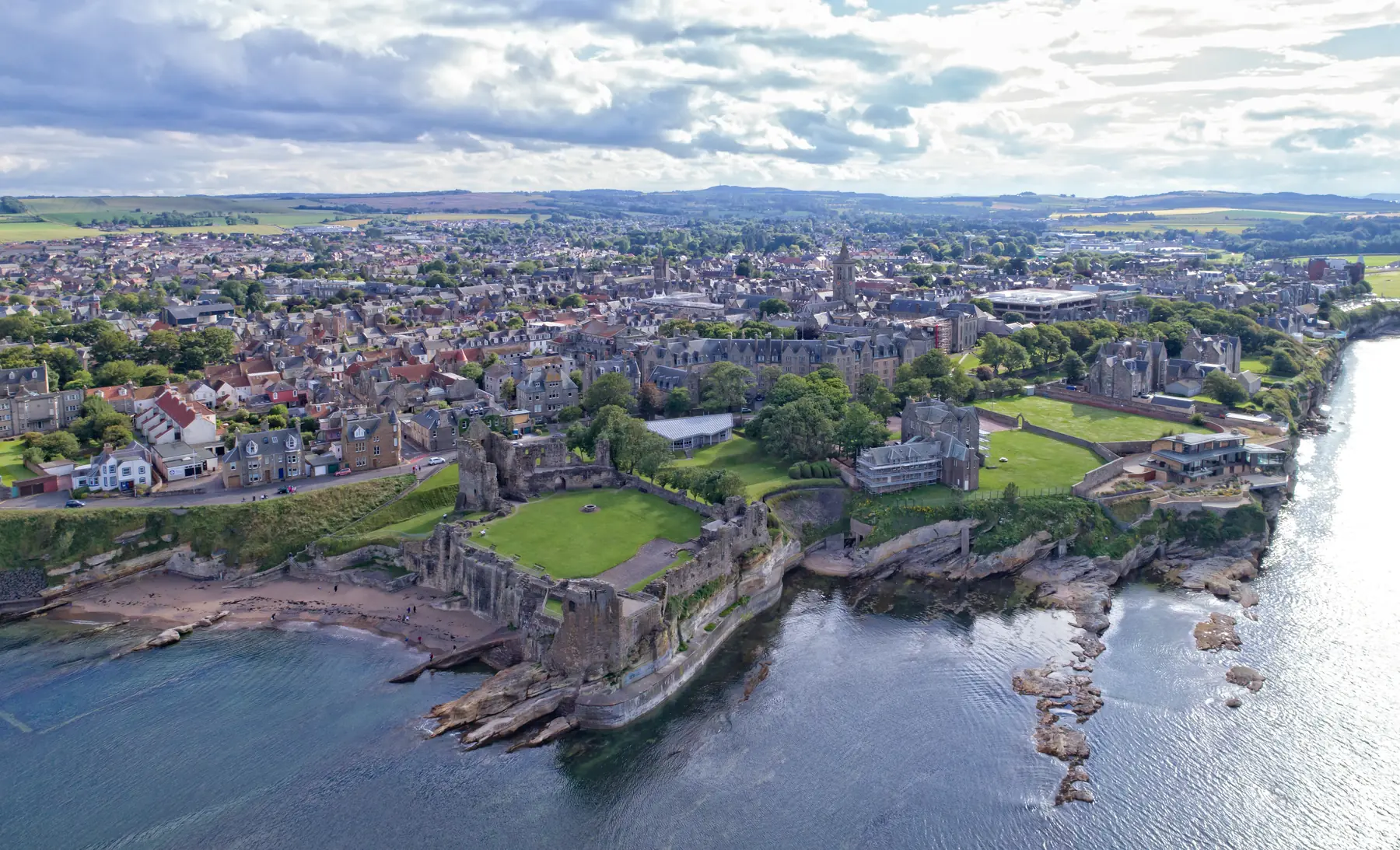
St Andrews has two beaches and a scrap of sand under the castle, and visitors treat them as one long seafront. They are not. West Sands runs north-west from the Old Course, two miles of dune-backed links beach. East Sands is a smaller bay on the other side of the harbour, below the cathedral, with the pier as a breakwater. Between them sit the old town, the ruins and St Andrews Castle. You walk from one to the other through the streets, not along the tide line.
Which beach you want depends on the wind, the tide, and whether you came to swim or to walk. The attraction page is the short version of East Sands. What follows is both.
From the first tee to East Sands is twenty to thirty minutes through town: The Scores, the castle, the cathedral, The Pends, the harbour. It is the walk that makes sense of the place. Relocating by car is how people lose the morning and then have to park twice.
West Sands is the famous one. East Sands is the local one. Do both if you have a day. If you have an hour, pick by the wind.
Three kilometres of flat, firm sand running from the Bruce Embankment toward the mouth of the Eden, backed by dunes and the links. It is one of the great British beaches: wide enough that it never feels busy, hard enough to walk or cycle on, and the setting for the opening of Chariots of Fire, which is why a certain number of people run along it as if they were being filmed.
Walking the full length and back takes about an hour and a half, entirely level. Out Head, at the far end, is where the estuary comes in and the Fife Coastal Path continues toward Tentsmuir National Nature Reserve. Turn round when you have had enough.
This is the golf beach. The Old Course runs along the inland side. On Sunday, when the course is closed to golf, you can combine a beach walk with a walk across the fairways. Stay off the greens either way.
It is also the exposed beach. A north-easterly here is character-building. On those days East Sands is the correct answer, not a consolation.
Dogs are restricted on the town end through the summer — 1 May to 30 September on the stretch nearest the links. The far end stays available. Follow the signs on the day.
Parking for the town end is Bruce Embankment, seasonal. Do not use the Links Trust clubhouse parks unless you are there for golf.
A curve of sand south of the harbour, below the cathedral, reached from the centre in about ten minutes by way of The Pends. It is smaller, more sheltered, and the beach the town actually uses: dog walkers, the sailing club, the leisure centre, a café, and the start of the coast path south toward the Rock and Spindle.
The view back over the harbour to the cathedral ruins and St Rule’s Tower is the angle most photographs of St Andrews are taken from. Stand at the southern end and look north.
Swimming is more realistic here than on West Sands, which is not the same as saying it is warm. The North Sea is cold in August and colder in May. The harbour mouth has currents. There are no lifeguards except in season, and even then only when the flags are up. The RNLI has been patrolling East Sands in the school summer holidays — in 2026, daily from late June into late August, 10am to 6pm on their published list. Dates move. No flags means no lifeguards. Swim between the red and yellow if they are flying.
East Sands is the watersports beach: kayaks, dinghies, the club on the shore. Give them room. The leisure centre has a pool for anyone who wanted a swim without the North Sea.
Dogs are welcome in a way West Sands is not, which is why locals walk here. Seasonal signs near the slipway still apply.
Parking is the beach’s own park by the leisure centre. Do not hunt The Scores.
Between the two beaches, under the cathedral, the Kinness Burn reaches the sea in a small working harbour that dries at low tide. Crab pots, a few boats, a wall to sit on. It is not a pleasure harbour. It is better for that.
St Andrews Pier runs out from it: a stone breakwater rebuilt with cathedral and castle masonry after the Reformation, when the ruins were a quarry. Walk the lower level out and back in twenty minutes. The upper walkway is a narrow ledge with no rail, used on the Sunday Pier Walk, and it is not the place for a child who might run.
In term, after Sunday chapel at St Salvator’s, the red gowns process down The Pends and out along the pier. Watch from the harbour. The first Sunday of the academic year is the largest. From the pier, East Sands is immediate; West Sands is a walk through town; the castle is along the cliff.
Directly below St Andrews Castle, a scrap of sand and rock with a natural pool cut into the shelf. Generations of students swam the length of that pool. It is not a beach day. It is a pause on the cliff path, and a reminder that the castle was built on a rock above a landing.
The pool is tidal. At the wrong state of the tide there is not much to see. The castle mine and the bottle dungeon are the reasons to come to this corner; the cove is what you notice on the way down.
Both main beaches are sand. Both shrink at high water; East Sands, being smaller, feels it more. West Sands remains a long walk even with the tide in. Check a tide table if you want rock pools at the southern end of East Sands or a full out-and-back on West. We do not print times here because they change twice a day.
The water is the North Sea off Fife. It is cold in every month. Late August and September are as warm as it gets, which is not warm.
West Sands has a reputation of being a poor swimming beach: offshore winds, a long fetch, a lot of space in which to get into trouble. RNLI patrols have still covered it in summer. Treat that as a reason to use the flags, not a reason to ignore the wind.
East Sands is the more sheltered swim and still has a harbour mouth. Children who want a paddle with a café behind them belong here. Anyone who wants two miles of sand belongs on West.
Never swim alone. If you get into trouble, a hand in the air. If you see someone else in trouble, tell a lifeguard or call 999 and ask for the coastguard.
At dawn on 1 May, students run into the sea. Confirm the gathering point locally — the university posts it — but the Dip has been on East Sands since 2011. It used to be the pool at Castle Sands; the numbers outgrew the cove. It is not on West Sands, however famous that beach is.
The ritual is said to wash off academic sins before exams. The evening before is the Gaudie, a torchlit pier walk for John Honey, who in 1800 went into the sea off East Sands after a wreck. If you are not taking part, it is a thing to know about rather than a thing to stand in the middle of. Our when to visit page is the calendar.
Northerly or easterly: East Sands, in the lee of the harbour.
A big sea: West Sands from the embankment, and the castle from The Scores. Marine weather here is the point of the town on those days, not an inconvenience.
Sun: East Sands faces the morning; West Sands holds the evening. June light on West Sands toward ten is the St Andrews that August photographs do not show.
A circuit that works. West Sands first thing, while it is empty. Back through the golf end and along The Scores, past the castle, to the cathedral. Down The Pends to the pier and East Sands for the afternoon. That is both beaches, both ruins, and about four kilometres of walking. The walks guide continues south from East Sands if the legs want cliffs.
Facilities sit at the town ends: toilets on West Sands toward the embankment, the leisure centre and café on East. Take water.
St Andrews is a headland with a beach on each side. The town is what joins them. Walk it.