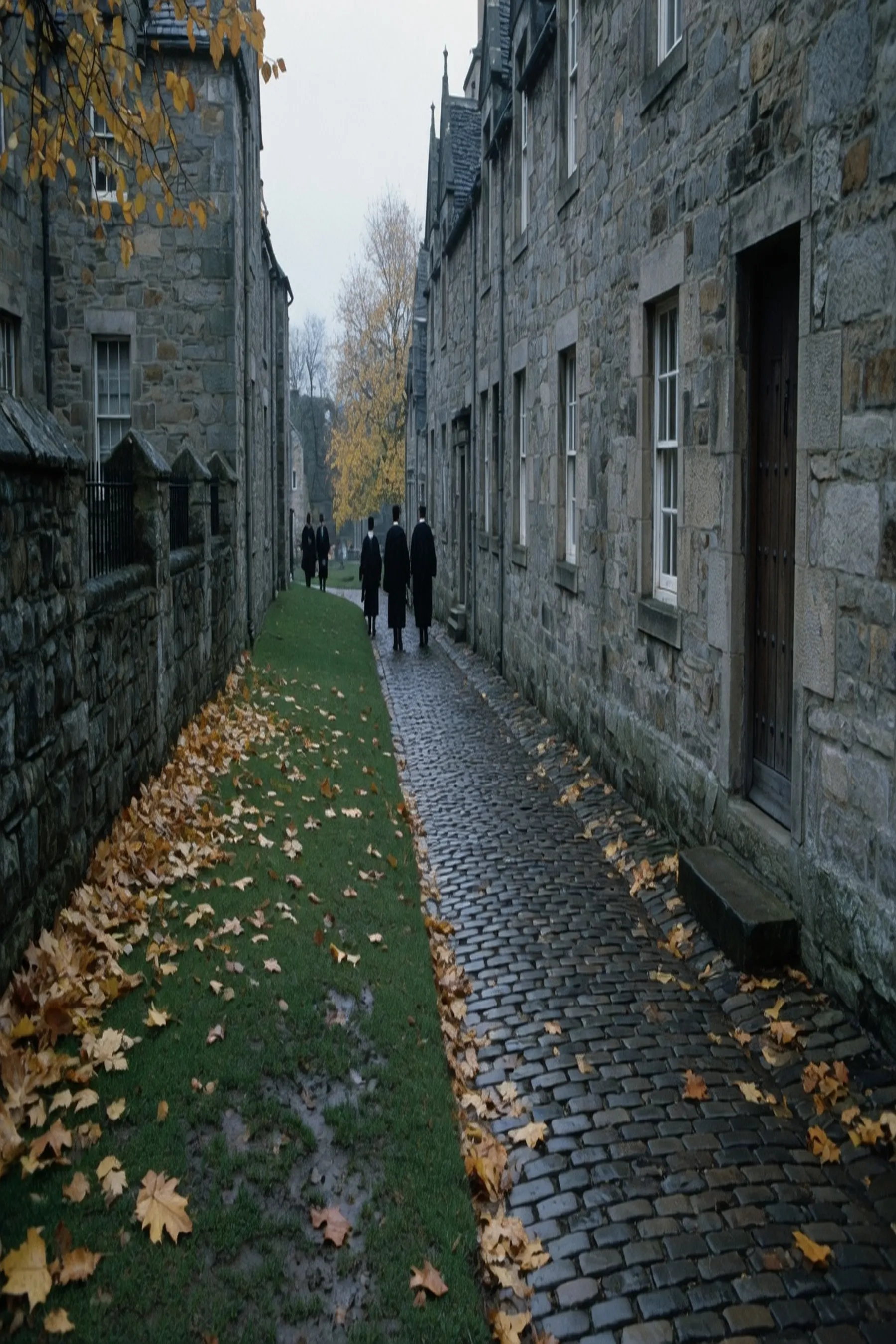
The University of St Andrews is not one campus behind a gate but the old town itself. Founded in 1413, it threads its colleges along North Street, Market Street and South Street, so a walk from the cathedral to the harbour passes through it whether you notice or not. The useful discovery is that the best of it asks nothing of a ticket: the quads are open to walk through, both museums are free, and the two living traditions — the Sunday pier walk and graduation week — happen in the open air where anyone can watch.
Golf and the ruined cathedral draw most people to St Andrews, and the university sits directly between them. The cathedral ruins and St Rule’s Tower stand beside the colleges and are managed by Historic Environment Scotland: the cathedral was dedicated in 1318, and St Rule’s Tower rises 33 metres with a view from the top for anyone who can climb its steps. The university predates the turmoil that unseated the cathedral and the golf links that made the town famous, and its stone quads are the oldest surviving working fabric of the place. Our old-town walk covers the three streets; this page is the university within them.
The quads are the surprise of a visit, because they are simply open. St Salvator’s Quad on North Street, St Mary’s Quadrangle on South Street and United College are outdoor spaces you walk through freely on foot during the day — no ticket, no gate, nobody asking your business. They are quadrangles of grey stone and lawn rather than rooms to be admitted to, and the university’s visiting page lists them as open. Wander in, keep off grass that is roped, and remember these are working courtyards: during term they are full of students moving between classes, and a quiet morning walk fits better than a posed photo outside a lecture door.
Most of the time the university’s buildings are not public rooms, and St Salvator’s Chapel is the exception that matters. It sits at the east end of the old town on North Street, its quad the one most visitors recognise, and it is not generally open as a sightseeing room. What it does offer is a Sunday service at 11am during university term, ecumenical and open to the public, so a visitor may simply sit in the chapel for the service. and it is worth planning a Sunday around; term dates vary, so check the chaplaincy pages rather than trusting the clock.
After the 11am service, the tradition that follows it is the pier walk. Every Sunday during term, students — many in the red gowns St Andrews is known for — walk in procession from the chapel down through the town to the harbour pier, a route that takes roughly half an hour. Anyone who wants to can follow on foot: it is a public procession through public streets, ending at the pier at the harbour. The walk commemorates John Honey, a St Andrews student who on 5 January 1800 swam out to rescue the crew of the ship Janet of Macduff when it foundered off the East Sands. The gown is part of the story: undergraduates wear red gowns by year group, and the university publishes the year-by-year gown rules, so what a gown-wearer is entitled to do — including the pier, a student privilege by tradition — is set down in its guidance, not guessed from memory.
The honest line is easy to state and often got wrong. Open to walk through: the quads and their grounds, and the two museums. Not open: teaching buildings, libraries, student halls and residences, which are for students and staff — and a visitor should not assume a door is open just because it is unlocked. Many list-style pages imply more is open than it is, and a reader following them ends up at a closed door. The university’s visiting page is the authority on what is open on any given day, so check it before you go rather than trusting a list from anywhere else.
The Wardlaw Museum on The Scores, near the castle, is free to enter and is the university’s main museum. Its current exhibition, “Divine Sky”, showing work by Sekai Machache, runs from 10 October 2026 to 9 May 2027, so it is open through the autumn and winter and into the spring. The Scores runs along the cliff above the sea between the castle and the Old Course, so the museum sits naturally in a morning that takes in the cathedral and the harbour. Check the university’s museums page for opening hours before you build the visit around it.
The other free museum has a door rule worth knowing before you walk there. The Bell Pettigrew Museum of Natural History is in the Bute Building on Queen’s Terrace, KY16 9TS, entered through St Mary’s Quadrangle from South Street or Queen’s Terrace, Door C; it is about half a mile from the bus station. The rule that matters: staff and students may enter Monday to Friday 1–5pm, but other visitors may enter only on weekdays during Fife school holidays — April, July, August and October — in the same 1–5pm window. A general visitor outside those weeks should check before going, or the door may be closed even though the museum is free. That detail is exactly what most “free museums in St Andrews” lists leave out, and it is worth reading on the museum’s own page.
Twice a year the town fills for graduation, and the winter ceremonies this year run on 1 and 2 December 2026, school by school. The university publishes which school graduates on which day and the procession route on its graduation pages, so read those for the exact schedule rather than trusting a remembered figure — the days move between years. What does not change is the effect on a visitor: accommodation books out, the quads and streets are busy with gowns and families, and the procession is a public spectacle on the streets that anyone can stand and watch. If your visit falls on those days, book rooms early and expect the old town to be slower to walk through and fuller at every table.
St Andrews is a different place in October than in July. The 2026–27 Martinmas semester’s key dates are published by the university, and term brings the students back, the gowns out and the quads busy. Summer empties the academic side of the town while the golf tourists take over; autumn returns the gowns and the Sunday processions. Raisin Monday, on 19 October 2026, falls within the next twelve weeks and is the day the academic year’s strangest tradition erupts in public, so a visit that crosses that boundary sees two towns in one week. Our when-to-visit page is the fuller calendar.
The red gowns are the town’s signature, and they are not one uniform: undergraduates wear them by year group, and the university publishes the year-by-year gown rules, so what any gown-wearer is entitled to do is set down rather than folklore. Raisin Monday, 19 October 2026, is the foam-fight tradition, usually around 11am on Lower College Lawn behind St Salvator’s Quad, after academic “children” have been presented with their raisins. It is a student event, but a very visible one for anyone in the town that morning. Watch respectfully from the edge; the lawn is a working part of a working university, not a stage, and the organiser’s page (yourunion.net/support/raisin) carries the day’s details.
The next three months carry several dates that change the town. The Alfred Dunhill Links Championship runs 1–5 October 2026 over the Old Course and the Fife links, filling the streets with players, caddies and spectators; check alfreddunhilllinks.com. Raisin Monday on 19 October is the university’s own day (yourunion.net/support/raisin). The Big Hoolie marks St Andrew’s Day on 28 November 2026 — check the organiser’s page for the town events programme. Winter graduation follows on 1–2 December, and the university’s December carol services in St Salvator’s Chapel have dates published closer to the time on the chaplaincy pages. Every one of these can move, so confirm on the organiser’s page before travelling for it.
The university sits where the cathedral, the castle and the harbour all meet, which makes it easy to fold into a morning you were taking anyway. Start at the cathedral ruins and St Rule’s Tower, walk North Street through St Salvator’s Quad, and carry on down to the pier and harbour — the whole line is short enough to do on foot without hurrying. If you want the one interior, come on a Sunday during term for the 11am service and stay for the pier walk that follows. On any other day, the two museums are the indoors to aim for, with the Bell Pettigrew’s school-holiday window checked first. Our cathedral and castle article is the deeper history beside it. And the single rule that makes the visit work: read the university’s visiting page the night before, because it is the one page that tells you which doors are genuinely open on the day you are there.