St Andrews old town is a walk, not a tour itinerary. Three streets on a headland, the harbour ten minutes below the cathedral, almost everything a first visit wants between the West Port and the first tee. You need to know which of the three streets — North, Market, South — to use, and which hour to use them.
This is not a cathedral article. The cathedral and castle guide covers the ruins; the walks guide covers West Sands and the coast path. What follows is the town itself.
From the West Port at the top of South Street to the east gable of St Andrews Cathedral is a single long street and a slight downhill. A full circuit — three streets, the harbour and pier, the castle, The Scores, a look at the Old Course — is about four kilometres and takes a couple of hours if you do not stop. You will stop.
That smallness is why you can do the old town before lunch, and why a Saturday in August can fill every pavement that matters. The hour does.
The bus station sits on the western edge of this walk. Once you are in, the car is a liability. See parking in St Andrews if you brought one, then forget it. Our car-free guide is the other half.
The old town is not a maze. It is a comb.
South Street is the ceremonial one: the West Port at the top, Blackfriars Chapel in a garden, St Mary’s Quad behind a wall, Holy Trinity, and the cathedral filling the view at the end. Walk it once for the buildings. Do not let the shops eat the morning.
Market Street runs parallel and does most of the eating. The eating guide is the list; this walk only needs you to know Market Street is the useful street when South Street is a shuffle.
North Street is the university street: St Salvator’s Quad, the initials of Patrick Hamilton in the cobbles — students walk around them — and a cleaner line toward the cathedral. In term it has gowns. In August it has people looking for the castle and overshooting.
Narrow wynds stitch the three together. Use them. A walk down South Street, back along Market, out along North, is the town in forty minutes and is free.
Start at the West Port. It is a sixteenth-century burgh gate, one of the few left in Scotland, and it is still the front door.
You do not need to go into every doorway. Blackfriars is a ruined chancel in a garden, two minutes. St Mary’s College quad has the holm oak and the thorn said to have been planted by Mary, Queen of Scots; you can usually walk in. Holy Trinity is the town church, where John Knox preached in 1559 shortly before the cathedral was stripped.
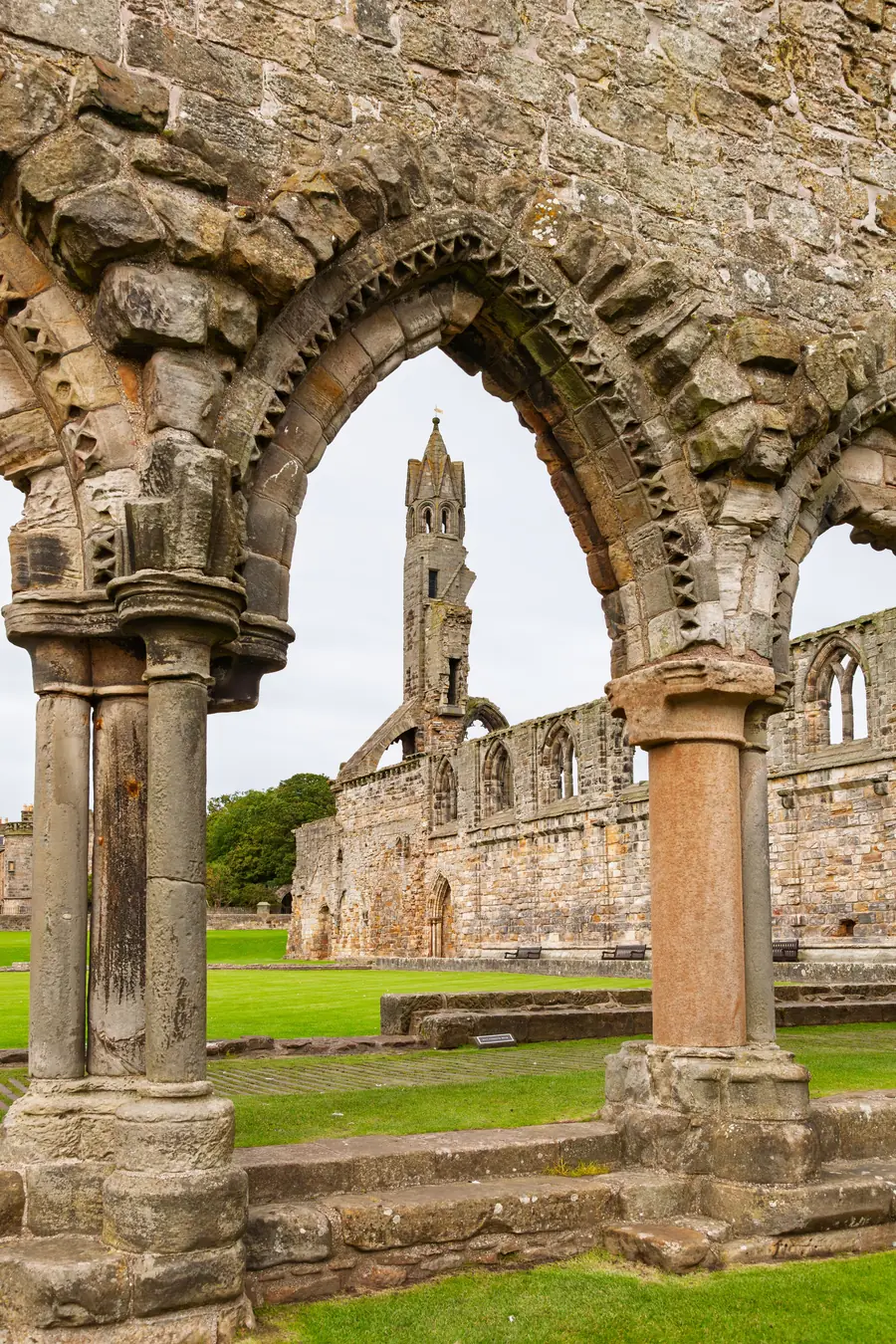
Then the street ends, and the east gable is in front of you: the largest church ever built in Scotland standing as a ruin at the end of a shopping street. Go into the precinct if you have the time — St Rule’s Tower is the view, the graveyard is the atmosphere — or walk the outside and keep moving. This page is the streets. The building has its own guide.
The Pends is the proper way down to the water: a vaulted fourteenth-century gateway that was the main entrance to the cathedral precinct, dropping you toward the harbour in five minutes. It frames the sea, and it is why arriving at East Sands by car feels like cheating.
The harbour is small and working. The Kinness Burn comes out here. At low tide it is mud and boats on the bottom. Sit on the wall. Look back. The cathedral and St Rule’s Tower sit on the skyline, which is the postcard, and also just the town from its own harbour.
St Andrews Pier runs out from the wall. Lower level for most people; upper walkway for the unfenced ledge the students use. Out and back is twenty minutes. In term, Sunday after chapel, the Pier Walk puts scarlet gowns on that ledge. Watch from the harbour rather than joining a procession that is not yours.
East Sands starts the other side of the harbour. A pause, not a beach day, unless you have read the sands piece and decided this is the swim.
Four hundred metres along the cliff from the cathedral, St Andrews Castle sits on its promontory above Castle Sands. You can walk the outside for nothing — the walls, the drop, the view back to the pier — or go in for the bottle dungeon and the 1546 mine. The mine is the thing; it is also low, narrow and closed when HES say it is closed. Check.
The Scores is the clifftop road from the castle to the golf links, and it is the best short walk in the town. University buildings on the inland side, the sea on the other, the Martyrs’ Monument, St Andrews Aquarium on the cliff, and St Andrews Bay opening as you come round toward the first tee.
Do not drive it looking for a space. Walk it. The Scores is how the ruins and the golf become one town rather than two attractions. Below the castle, Castle Sands is a cove and a tidal pool. Glance down. Keep the hour for The Scores.
The western end of The Scores delivers you to the thing St Andrews is famous for, and you do not need a handicap to use it.
The first tee of the Old Course sits at the end of a public street. Watching someone hit the opening shot of their life is free. The R&A clubhouse is beside it; The R&A World Golf Museum is opposite.
On Sunday the Old Course is closed to golf and reverts to common land. Walking up the eighteenth, standing on the Swilcan Bridge, looking back down the fairway, is a St Andrews institution and costs nothing. Stay off the greens. Our golf guide is the rest. This walk only needs the street and the Sunday.
West Sands begins here if the legs want two miles of sand. The old town ends at the clubhouse.
The university is not a campus on a hill. It is the town.
St Salvator’s on North Street and St Mary’s on South Street are the two quads worth stepping into. The Wardlaw Museum on The Scores is free; a rooftop terrace looks over the bay. The Bell Pettigrew opens on a thinner timetable — check, because a closed door is the usual visitor experience.
In term the gowns tell you what month it is. Raisin Weekend in the autumn semester takes over St Salvator’s Quad; if you did not come for foam, walk South Street that day. When South Street is slow, cut through a wynd, come out on Market, keep going.
Early is the rule in July and August. The precinct, The Pends and the pier at eight or nine are the old town. At noon they are a queue with a view.
Sunday morning in term is the Pier Walk. Sunday any time of year is the Old Course as a park. Those two facts alone are worth shaping a weekend around.
A rough day is a Scores day. The castle with a big sea under it does more for the atmosphere than a blue sky over South Street. The three streets are short enough that a shower is a doorway, not a write-off. See St Andrews in the rain.
Graduation in June and an Open year are the weeks when this plan is a crowd on purpose. Check The Open rather than a date in an old article. For the ordinary calendar, when to visit is the page.
West Port. South Street to the cathedral, looking, not lingering in every shop. Precinct or not, as you prefer. The Pends to the harbour and the pier. Back up, along the cliff to the castle. The Scores all the way to the first tee. If it is Sunday, the eighteenth. If it is not, the museum or simply the view. Return on North Street, so you have walked all three.
That is the old town. Two hours without stops, four with them. The beaches, Craigtoun Country Park, St Andrews Botanic Garden and Scotland’s Secret Bunker hang off the edge of it. They are other days.
St Andrews was laid out for people on foot. The streets are the point. Use them before someone tries to park on them.