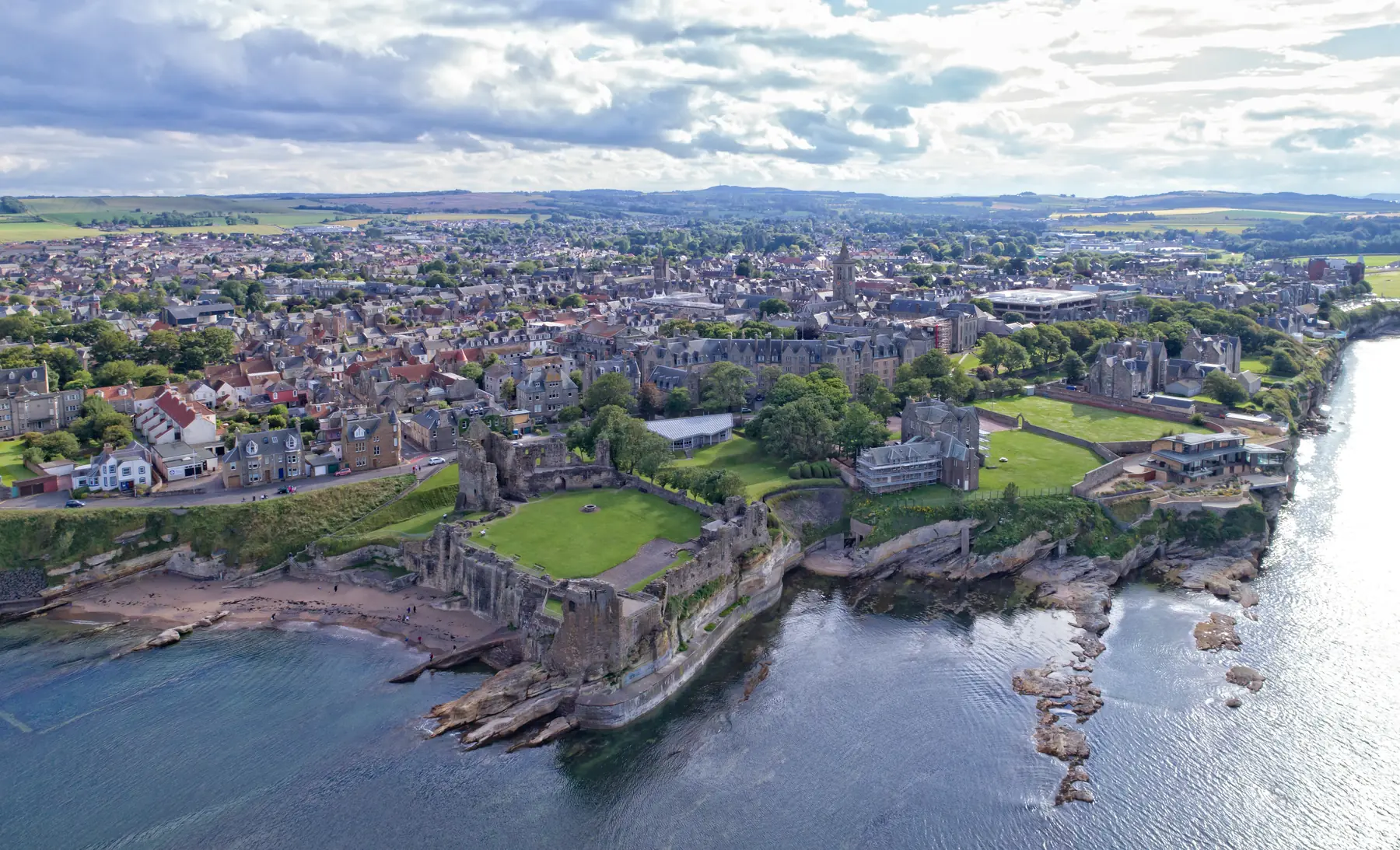
St Andrews is a small town that punches above its weight with children, largely because of what surrounds it. There is an aquarium on the cliff, an Edwardian country park with a boating lake four kilometres out, a Cold War nuclear bunker ten kilometres away that is entirely underground, three miles of flat sand, and a castle with a siege tunnel you can crawl through.
It is also compact, walkable and safe, and the university keeps the town alive out of the holiday season in a way that most Scottish seaside towns are not.
On The Scores, on the cliff between the castle and the golf links. A small aquarium with seals, penguins, meerkats and reptiles as well as the tanks, and a terrace looking out over the bay. Around an hour and a half.
The ruin on the promontory, and much better with children than a ruin usually is, because of two things. The bottle dungeon is a pit cut into the rock, shaped like a bottle, from which nobody escaped. And the mine and countermine is a genuine siege tunnel from 1546 — attackers dug towards the walls, defenders dug to intercept them, and you can go down and along both, which is a rare thing to be allowed to do at a historic site.
It is low, narrow and unlit in places. Children love it. See our St Andrews Castle page.
Next door. The cathedral is a ruin of enormous scale, and beside it stands St Rule’s Tower, thirty-three metres high with a spiral staircase to the top and the best view in St Andrews from it. The climb is a genuine effort and the reward is the whole town, both beaches and the coast.
West Sands is three kilometres of flat firm sand with dunes behind it — space for kites, cricket, bikes and running about, and the Chariots of Fire beach for anyone who wants to explain that to their children.
East Sands is smaller, more sheltered, has a leisure centre with a pool, and is next to the harbour.
Castle Sands below the castle has a natural rock pool cut into the shelf.
Four kilometres south-west and the family day out of choice. An Edwardian estate park with a boating lake and island, the Dutch Village built on the water, a miniature railway, glasshouses, a play area, crazy golf and woodland. Entry to the park is free; the attractions charge individually or by wristband.
Ten kilometres south. An underground nuclear command bunker built in the 1950s under a farmhouse, thirty metres down behind blast doors, kept secret until 1993 and now a Cold War museum with the operations rooms, the dormitories, the broadcasting studio and the chapel preserved.
It is entirely underground, weatherproof, and genuinely eerie. It suits older children — say eight upwards — and is one of the more memorable attractions in Fife. See our Secret Bunker page.
Near Cupar, thirteen kilometres west. Pick-your-own fruit in season, a giant maize maze, play barns and a café. A reliable half day.
Ten kilometres north across the estuary — dunes, pine forest, a huge flat beach and a large seal colony hauled out on the sands. Free, wild and a complete contrast to the town.
It would be odd not to mention it. St Andrews has courses for every level, and two of them work with children: the Balgove Course, a short nine-hole beginners’ course on the links, and The Himalayas — the St Andrews Ladies’ Putting Club’s famous eighteen-hole putting green beside the Old Course, which is open to the public, costs very little and is enormous fun on a wildly undulating surface. Our golf guide has more.
Scotland’s Secret Bunker is thirty metres underground. The aquarium, the R&A World Golf Museum, the Wardlaw Museum and the St Andrews Museum are all indoors, and the East Sands leisure centre has a pool. Our wet weather guide has the list.
The town has a large student population and prices to match at the informal end. The Tailend on Market Street is the fish and chip institution; Little Italy and the pizza places cover the rest; and the Cheesy Toast Shack at East Sands is a beach hut that does exactly what the name says and has a devoted following. Ice cream is well provided for. Our eating guide has more.
Getting here. The nearest station is Leuchars, ten kilometres west, with two trains an hour from Edinburgh taking about an hour, and buses connecting into St Andrews. There are direct trains from London King’s Cross on the Aberdeen service.
Parking. The town centre is small and busy; there are car parks around the edge and it is easier to leave the car and walk.
Term time. The university dominates the town from September to May and the atmosphere changes completely in the summer, when the students go and the golfers arrive.
Wind. It is the east coast. West Sands is glorious and exposed.
A town day. Castle first thing for the bottle dungeon and the siege mine, then along the cliff to the cathedral and up St Rule’s Tower for the view. Lunch on Market Street. Afternoon on West Sands with kites and a football, finishing at the Himalayas putting green beside the Old Course, which is cheap and enormous fun. Nothing is more than fifteen minutes’ walk from anything else.
An out-of-town day. Craigtoun Country Park for the morning — the boating lake, the miniature railway and the Dutch Village — then either Scotland’s Secret Bunker in the afternoon for older children, or Cairnie Fruit Farm’s maze for younger ones. Both are within fifteen kilometres.
Under five: West Sands, Craigtoun’s boats and railway, the aquarium, the Kinness Burn ducks.
Five to eleven: the sweet spot. The castle mine, St Rule’s Tower, the Himalayas, Craigtoun, Cairnie Fruit Farm.
Teenagers: Scotland’s Secret Bunker, the coastal path to the Rock and Spindle, surfing and watersports at East Sands, and Dundee’s V&A half an hour north.
Craigtoun Country Park for a full day; the castle’s siege mine and the climb up St Rule’s Tower in the town; Scotland’s Secret Bunker when it rains.
Yes — the 1546 mine and countermine are open and you can walk and crawl through them. They are low and narrow in places.
It suits about eight upwards. It is underground, dimly lit and the subject matter is nuclear war, which is not for everyone.
West Sands for space; East Sands for shelter and the leisure centre next to it.
Yes — the Balgove course is a short beginners’ nine, and the Himalayas putting green beside the Old Course is cheap, public and great fun.