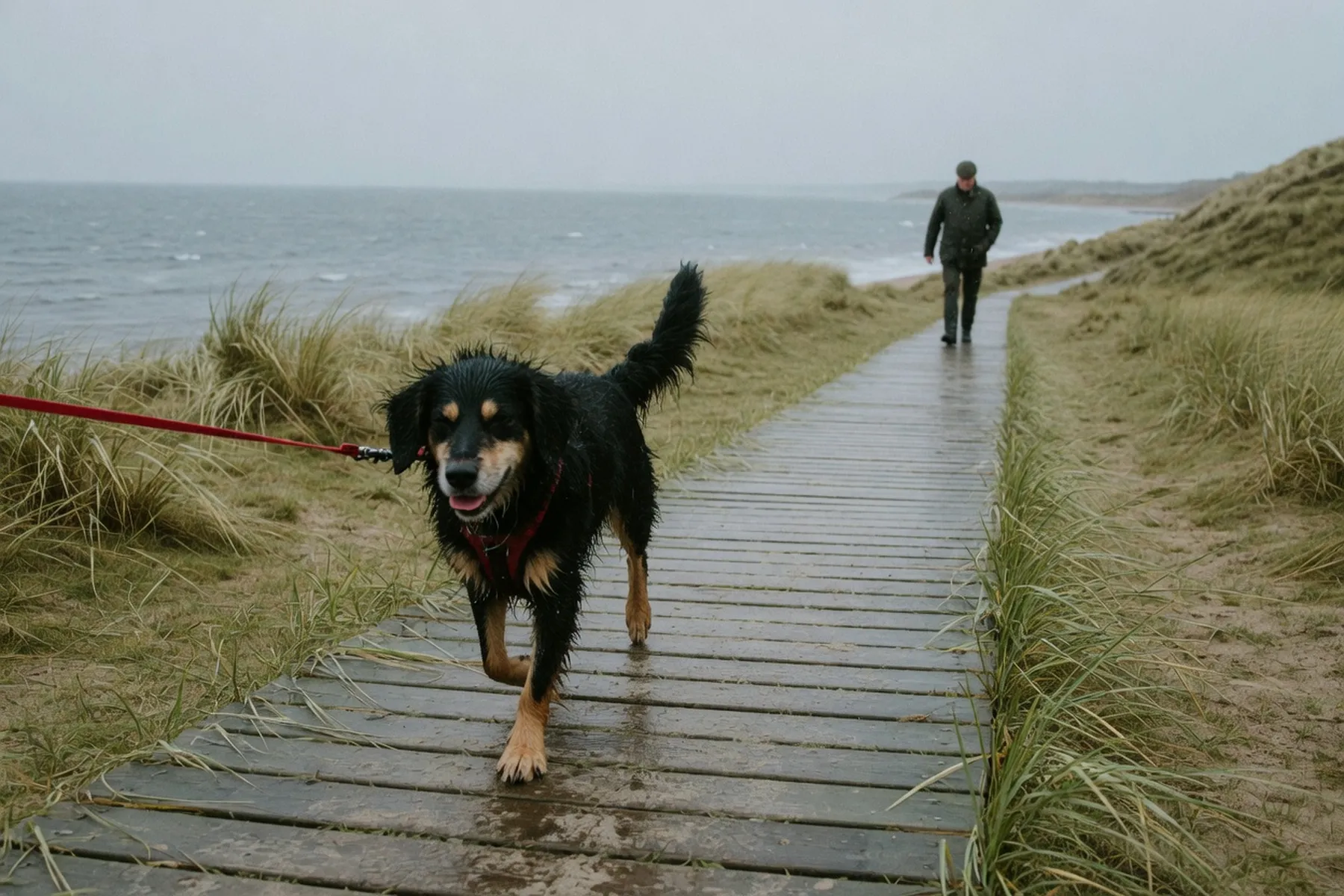
A dog changes the shape of a day in St Andrews, mostly for the better. The town has two long beaches, a coastal path that runs north and south, and a set of rules that are less obvious than they look. The good news first: dogs are genuinely welcome here. The honest part is that the welcome comes with conditions that shift by season, by beach and by the field you happen to be crossing. This is the practical version — where the dog can run, where it must be on a lead, and which doors will still open for the two of you.
West Sands is the long one — about two miles from the Old Course end toward the Eden Estuary — and it is zoned, with sand-yachting at one end and the bathing areas marked further along. East Sands is smaller and more sheltered, tucked south of the old harbour beside a play area, toilets, parking and a café. Both beaches hold the Keep Scotland Beautiful 2026 Beach Award and have seasonal RNLI lifeguards in summer. What matters for a dog is that the two beaches carry different rules, so it is worth knowing which is which before you unclip the lead. The full beach guide is our East and West Sands page.
No council or trust page publishes fixed dog dates for West Sands; what Fife Coast and Countryside Trust does ask is a lead or close control on the seashore in the bird-breeding season, usually April to July. The ranges quoted on third-party dog sites do not agree with each other, which is why you should follow the signs on the beach rather than trust a remembered range. If you want the current rules before you set off, the West Sands Ranger Service answers at [email protected] or 01334 466711, and Fife Coast and Countryside Trust manages the beach’s outdoor access on the council’s behalf. Wherever the dog runs, keep to the marked boardwalk and access points through the dunes and stay off the dunes themselves — they are part of the Firth of Tay and Eden Estuary Special Area of Conservation.
East Sands is the simpler option: dogs are generally allowed all year round, with the same breeding-season request for a lead or close control. Again, the signs at the access points are the rule that counts. The beach sits south of the old harbour — a short walk from St Andrews Pier — with the play area and café right behind the sand. Because the Fife Coastal Path runs through it, a dog on East Sands is often mid-walk rather than at the end of one, and the sand shifts suddenly near the waterline, which matters more for a dog chasing gulls than for you on the path.
The rules most people miss are not beach rules at all. The Scottish Outdoor Access Code, applied in Fife by Fife Coast and Countryside Trust, asks for dogs under close control or on a lead in recreational and public places, and to pick up after them. Close control means the dog responds to your commands and stays at heel; a short lead means two metres or less. There is also law behind the walk. Every dog in public in Scotland must wear a collar and tag with your name and address, and must be microchipped by eight weeks old. It is worth a two-minute check before you leave, because a dog without a tag is the easiest thing on the beach to get wrong.
Dogs are welcome on the Fife Coastal Path, and it is the best way to turn a beach visit into a proper walk. South from East Sands the path climbs over the Kinkell Braes toward Crail; north it runs toward Leuchars and the Eden and into Tentsmuir National Nature Reserve. The shore and grassland stretches carry the April-to-July nesting guidance, and any section through a field with livestock means a short lead. The rockier stretches are tidal, so time the Kinkell Braes section for low water rather than racing the sea. Our Fife Coastal Path from St Andrews page has the route, the tides and the buses back.
The links around the town are not an open beach. On the golf courses, including the Old Course, dogs should be on a short lead of two metres or less, and never on the greens; stand still while players are hitting. The same restraint applies near the fairways even where there is no fence. The dunes are a separate rule from the fairways: use the designated boardwalk and access points only, because the dune system is protected habitat, not a shortcut. If golf is part of the plan, our golf in St Andrews page explains how the links actually work.
From April to July, ground-nesting birds are the reason the shore and grassland stretches tighten up. Through those months dogs should be on a short lead or under close control on the seashore, and kept from approaching or chasing nesting birds. The same season is lambing time inland: keep a dog on a short lead or close control in any field with livestock, and never into a field with calves or lambs. If cattle turn aggressive, let the dog go and take the shortest safe route out yourself — the dog can be gathered later, and that is the outdoor access guidance’s own advice.
The North Sea is the obvious dog swim, and there is one rule most owners have never met: do not let the dog swim after spot-on flea or tick treatment, because the chemicals in some products wash off into the water. If the dog has had a treatment recently, check the pack before the beach. A rinse with fresh water afterwards helps the coat and stops a wet dog carrying sand into the car.
Dook, the beach café by the West Sands car park on West Sands Road, welcomes dogs inside and out, with water bowls and treats, and has run under Robbie and Sam Larg since 2022. It keeps roughly a nine-to-four-or-five day, year round, but the hours move with the weather — check the Dook page on Facebook or Instagram before you walk down. Elsewhere the rule is to ask, not assume. A café with an outside hatch may welcome a dog at the door and not inside, and the answer often changes by season, so a thirty-second question beats a disappointed walk.
The Criterion on South Street is the one pub you can take on the operator’s own word: open and licensed from 10 am every day of the week and dog-friendly, no reservations, a small family-run bar in the same family since 1874, with cask ale, more than 160 whiskies, 80-plus gins and the CRI pies. For any other pub, the check is the same as the cafes: ask before you sit down, because a pub that welcomes a dog in the bar may draw the line at the dining room.
Bins and fouling are the unglamorous part of walking a dog here, and Fife enforces them. Dog fouling carries an £80 Fixed Penalty Notice, £100 if unpaid after 28 days, and refusing to give your name and address to the Safer Communities Team can reach £500 — the team answers on 03451 55 00 22, and the council’s own page is the place to confirm the current wording. On the links, the St Andrews Links bye-laws add one more: dogs must not be loose so as to annoy golfers, and must be on a lead when crossing the Old Course at Grannie Clark’s Wynd. The Links Trust bye-laws page is where the current wording lives.
The quiet-season beaches are the dog’s best version of St Andrews, and the town’s winter calendar has two dates worth knowing. The Big Hoolie on St Andrew’s Day falls on Saturday 28 November 2026, organised by BID St Andrews, with the street programme still to be announced — check standrewsday.com, the organiser’s page, before you travel. A dog on a lead can enjoy a street event, but the crowds and food stalls mean close control rather than a free run. The first-Saturday market on South Street welcomes dogs on leads, on 7 November and 5 December 2026 by the council’s market notice — check marketsbetweentwofirths.com, the organiser’s page, to confirm. And when the market and the Big Hoolie are over, the beaches in early winter are exactly what a dog owner hopes for: empty, open and yours.